
Selection and budget
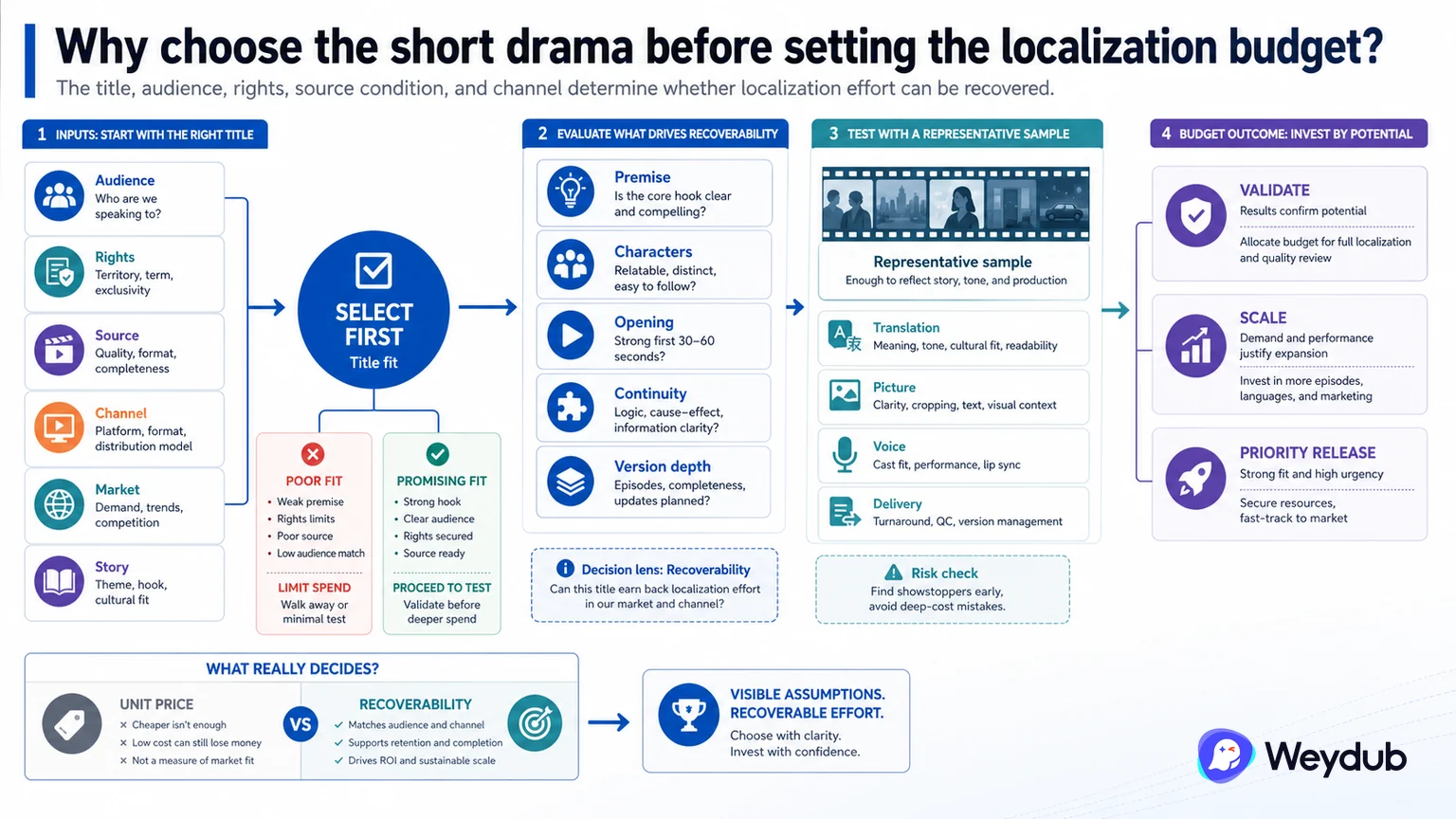
Why choose the short drama before setting the localization budget?
The title, audience, rights, source condition, and channel determine whether localization effort can be recovered.
Key conclusions
- Evaluate story and market fit before comparing per-minute localization prices.
- Check rights and source readiness as part of selection.
- Use a representative sample to decide whether a title deserves deeper language investment.
A low production quote cannot rescue a title that lacks a clear audience, usable rights, or a source that is expensive to recover. Conversely, a promising series may justify deeper dubbing and review if the story and channel have a credible path to recovery.
Selection should look at premise, characters, opening episodes, episode continuity, target market, channel, rights, source materials, and expected version depth. A sample should include the scenes most likely to reveal translation, picture, voice, or delivery risk.
Once the title and release hypothesis are clear, split the budget into validation, scaled production, and priority release tiers. Keep the assumptions visible so a failed sample changes the plan instead of becoming sunk cost.
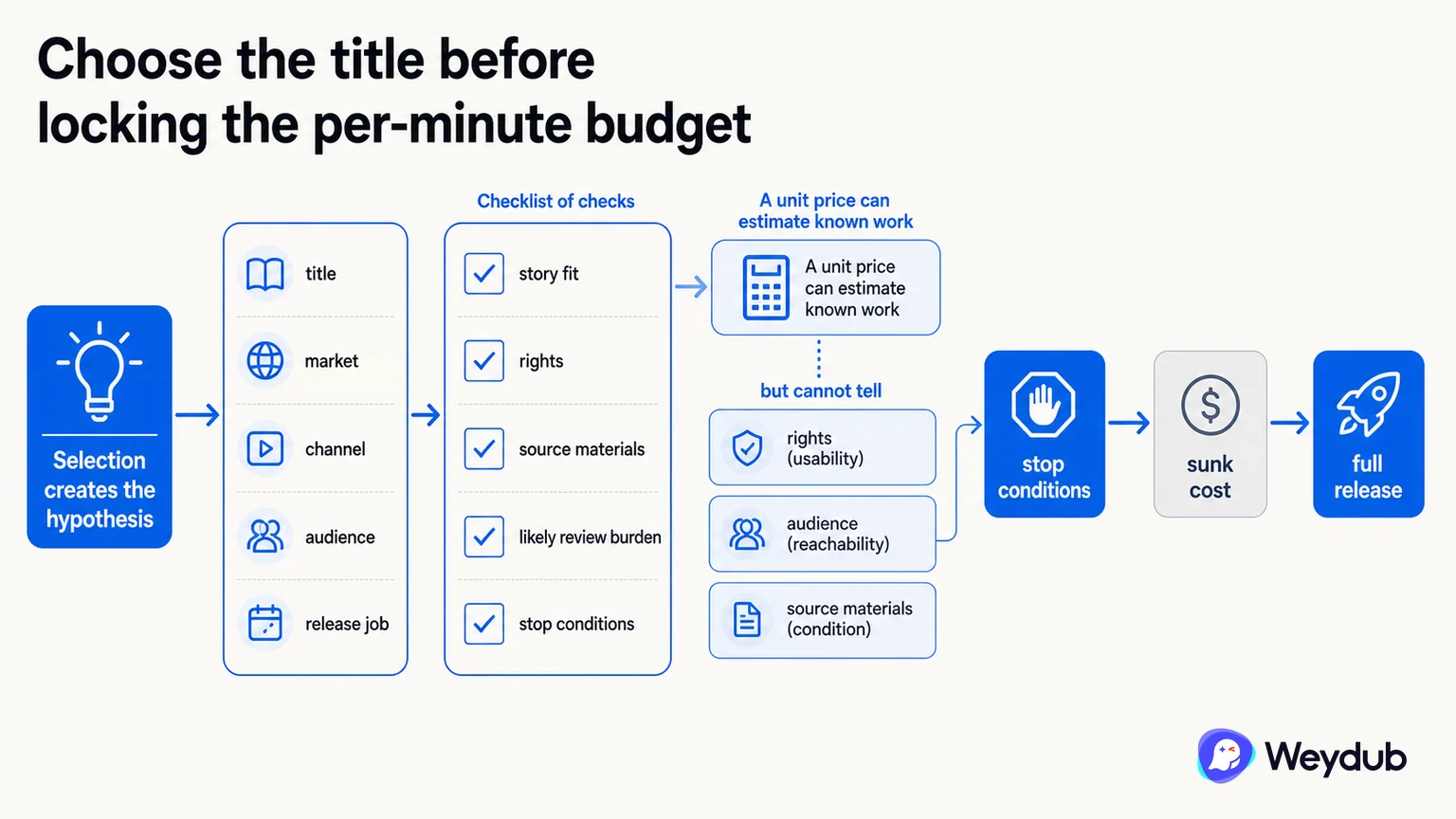
Choose the title before locking the per-minute budget
A unit price can estimate known work, but it cannot tell you whether a title has usable rights, a reachable audience, or a source condition that makes the version recoverable. Selection creates the hypothesis that each investment tier is meant to test.
- Name the market, channel, audience, and release job.
- Check story fit, rights, source materials, and likely review burden.
- Define stop conditions before sunk cost turns into an automatic full release.
Evaluate content, rights, and materials together
A promising premise may still need a different channel or locale. A strong rights position may still come with low-resolution hard subtitles. A clean master may still fail to fit the audience. Keep these gates separate so one strong signal does not hide another weakness.
| Gate | Question | If uncertain |
|---|---|---|
| Content | Who should watch and why now? | Create a focused hypothesis |
| Rights | Can the intended territory and channel be used? | Obtain or narrow authorization |
| Materials | Can the planned version be produced? | Recover source or change tier |
| Sample | Does the story and workflow pass? | Fix cause, retest, or stop |
Use representative samples and investment tiers
A useful sample includes the opening, a relationship change, an emotional peak, multiple speakers, and a complex picture or subtitle moment. Then separate validation, scaled production, and priority-release budgets so the next payment buys a specific reduction in uncertainty.
- Define the market and channel task.
- Screen premise, characters, and opening episodes.
- Verify rights, source, audio, and episode order.
- Run a representative localization sample.
- Continue, supplement, change scope, or stop with reasons recorded.
Carry approved material into production
A passed sample should leave behind source subtitles, role and terminology decisions, exceptions, and acceptance criteria. Reusing that context is what makes a staged budget a real learning path rather than a sequence of disconnected quotes.
Frequently asked questions
Does strong domestic performance justify a high overseas budget?
No. It is a signal for a market hypothesis, not proof of fit for another audience, channel, rights scope, or language version.
Is a subtitle version always the low-budget tier?
No. Budget depends on the release task, review depth, and asset requirements, not the label alone.
Related theme: Short-drama globalization
Weydub workflow
Take the next production step
Move from a market and source decision to a reviewable multi-episode localization workflow.