
Release strategy
Translated series, local remake, or original production?
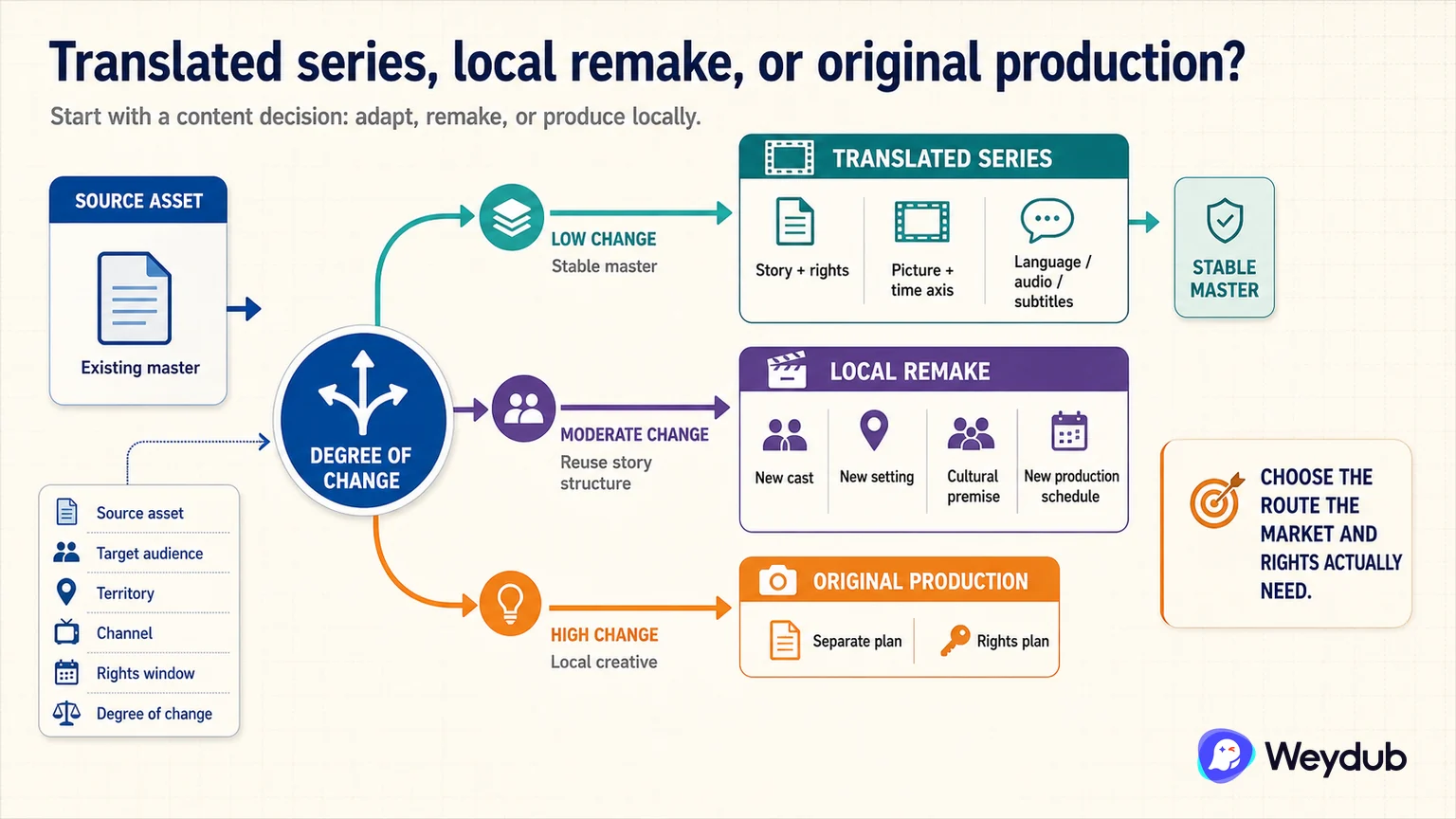
Short-drama globalization starts with a content decision: adapt an existing story, remake it for a market, or produce locally from the beginning.
Key conclusions
- Use an existing master when the story and rights are reusable across markets.
- Choose a remake when local casting, setting, or cultural structure is part of the value.
- Treat an original production as a separate production and rights plan, not as a cheaper translation path.
These three routes share a commercial goal but create different production obligations. A translated series keeps the source story, picture, and time axis, then changes language, audio, subtitles, and selected on-screen text. A remake changes more of the creative asset and therefore needs a new production schedule, cast, rights chain, and quality process.
The choice should follow the amount of sameness the audience and rights holder actually need. If the story, characters, and footage already work for the target market, preserving a stable master makes localization and later revisions easier to manage. If the market depends on local performers, settings, or a substantially different cultural premise, forcing a translation workflow onto the project can hide the real scope.
A useful first brief names the source asset, target audience, territory, channel, rights window, and expected degree of creative change. That brief prevents a team from comparing a translation quote with a remake budget as though they were the same service.
Three routes buy different kinds of certainty
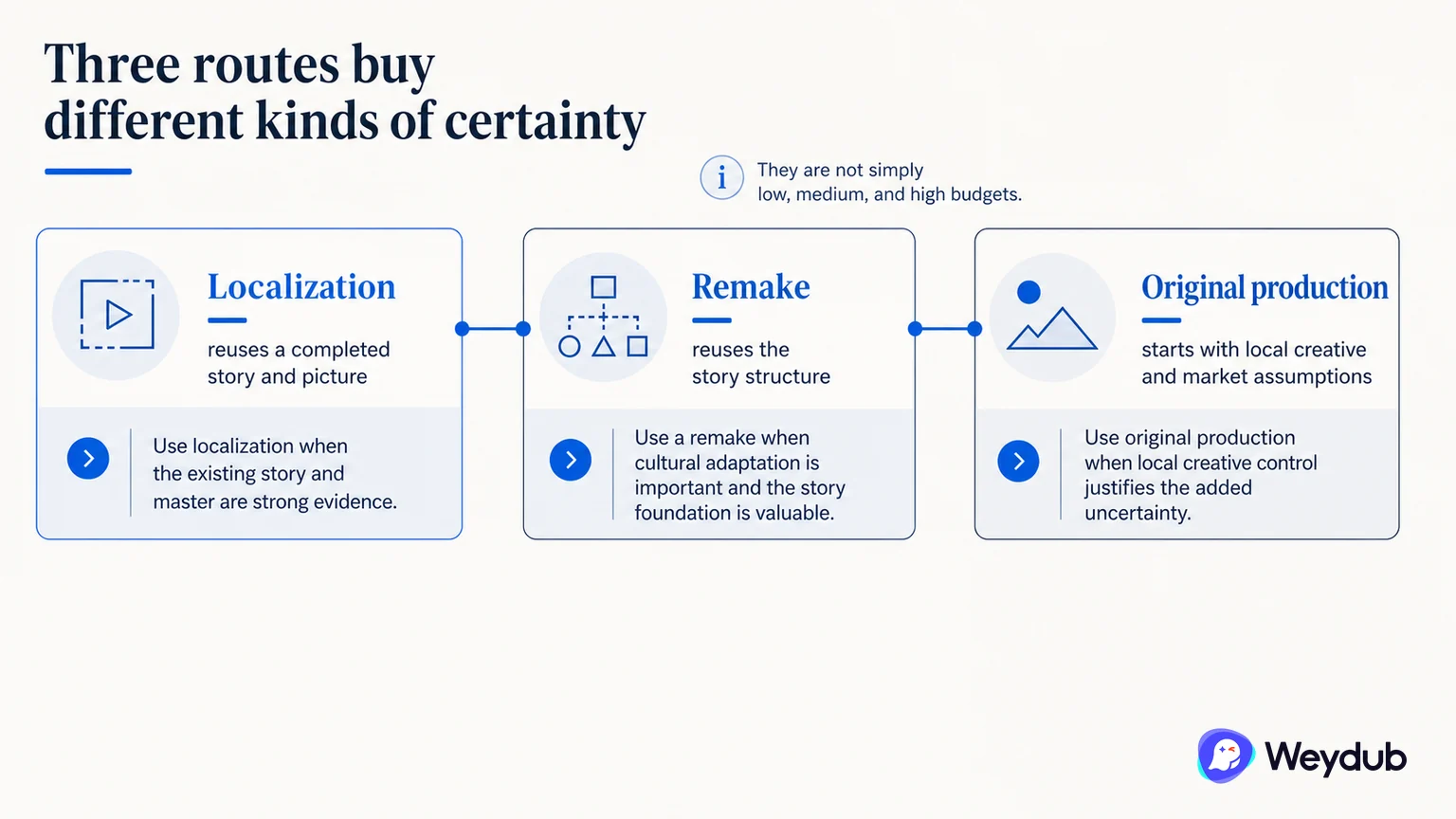
Localization reuses a completed story and picture, a remake reuses the story structure while rebuilding production for the target market, and an original production starts with local creative and market assumptions. They are not simply low, medium, and high budgets.
A translated release gives evidence about the existing story and audience response. A remake may improve cultural fit but introduces script, casting, production, and rights decisions. An original can fit the market deeply, but it carries the most uncertainty about story, production, and audience discovery.
- Use localization when the existing story and master are strong evidence.
- Use a remake when cultural adaptation is important and the story foundation is valuable.
- Use original production when local creative control justifies the added uncertainty.
Compare the downstream workload
The cost of a route includes rights, script adaptation, production, language work, picture, sound, review, delivery, and the time needed to learn whether the release works. A cheaper first export can create more rework if the source, rights, or channel package is not usable.
A representative localization sample can test story, language, voice, picture, and channel fit before the team commits to a remake or original production. The result is evidence for a defined audience and release scope, not a universal market claim.
| Route | What it reuses | Main new work |
|---|---|---|
| Localization | Story, cast, finished picture | Language, subtitle, voice, picture and delivery |
| Remake | Story structure or premise | Script, cast, production, local adaptation |
| Original | Usually only the market brief | Creative, rights, production, and localization plan |
Choose with a staged test
Define the audience, territory, channel, rights scope, and evidence that would justify a deeper route. Keep the sample, version, and assumptions linked so the next decision can distinguish story weakness from language, packaging, or acquisition weakness.
- Define audience, territory, channel, and rights scope.
- Create a representative sample for the least expensive credible route.
- Review story, language, picture, voice, and delivery together.
- Record what the sample proves and what remains unknown.
- Escalate only when the evidence supports it.
Frequently asked questions
Is localization always the cheapest option?
Not necessarily. Difficult picture, rights, language, or channel requirements can change the total cost.
Can a localization sample validate a remake?
It can reveal whether the story and audience promise travel, but a remake still needs its own script, production, rights, and local-market validation.
Related theme: Short-drama globalization
Weydub workflow
Take the next production step
Move from a market and source decision to a reviewable multi-episode localization workflow.