
AI production
Why character consistency is the hard part of AI comics
A series needs stable identity across faces, costumes, roles, scenes, text, and voice even when each frame can be generated independently.
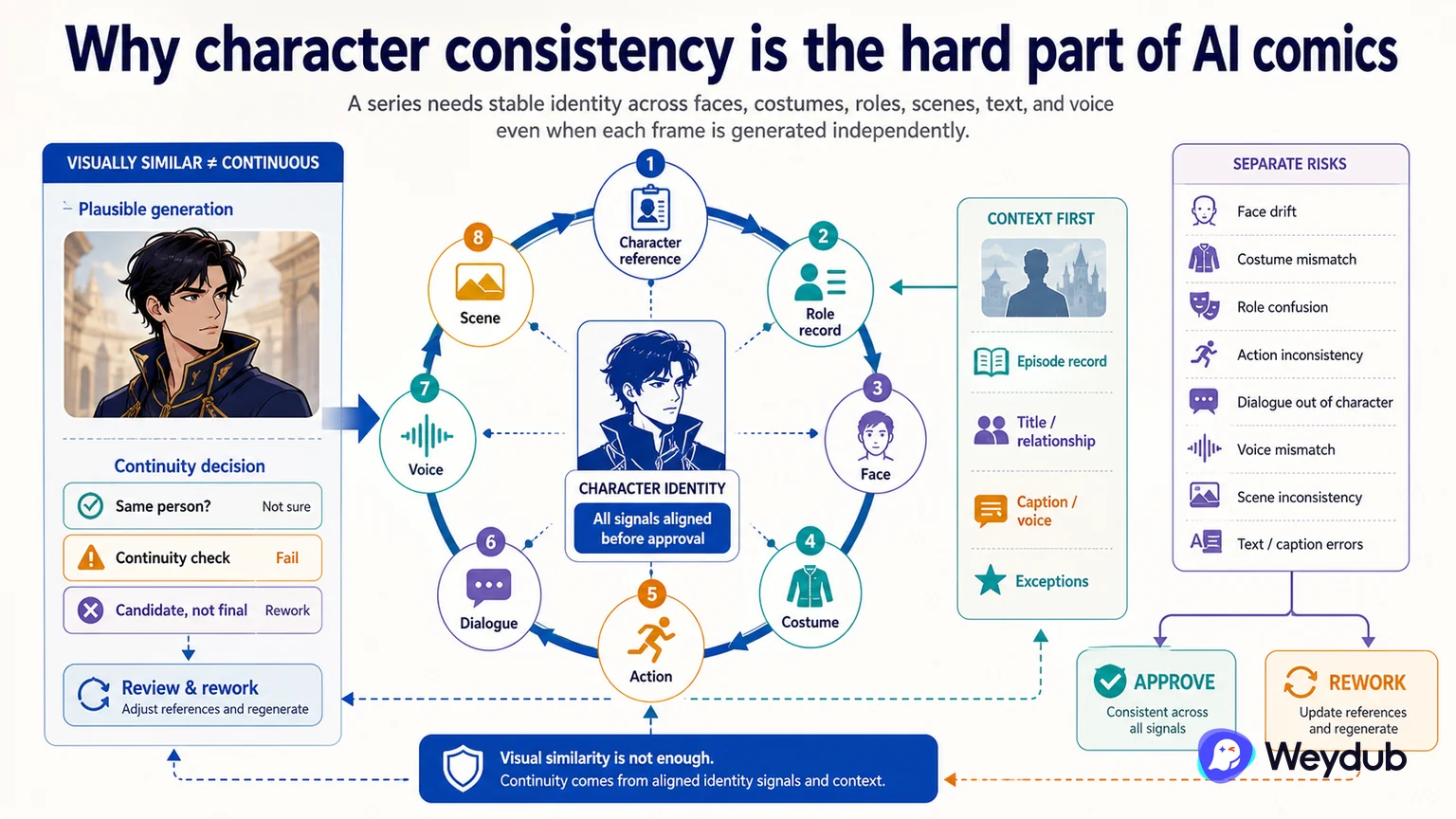
Key conclusions
- Maintain a character reference and role record across episodes.
- Review costume, face, action, and dialogue attribution as separate risks.
- Treat a generated image as a candidate until continuity and story context are accepted.
AI comics and animated story formats often produce many visual candidates quickly. The problem is deciding whether the same character still reads as the same person after a costume change, a different angle, a new emotion, or a new scene.
Character identity also lives outside the face. A role may be established by a title, relationship, voice, caption, or repeated action. If those signals disagree, subtitle translation and dubbing can assign the wrong line or tone even when the image looks plausible.
A lightweight character bible can record names, aliases, relationships, visual references, voice choices, and exceptions. The goal is not paperwork for its own sake; it is a reusable context that makes review and rework more precise.
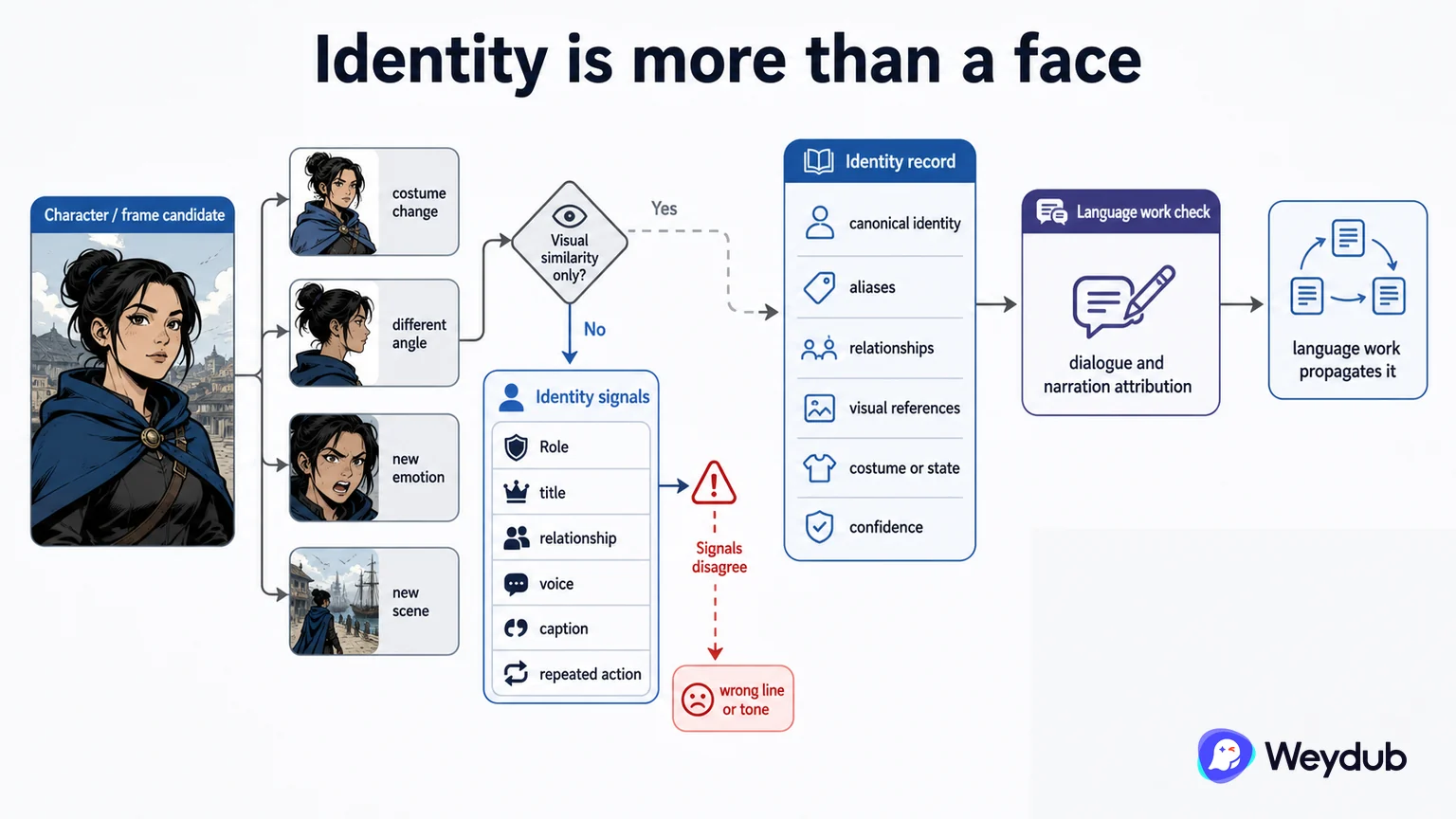
Identity is more than a face
AI comics and animated story formats can produce visual candidates quickly, but a series must decide whether a character remains the same after a costume change, a different angle, a new emotion, or a new scene. Role, title, relationship, voice, caption, and repeated action can be stronger identity signals than visual similarity alone.
If those signals disagree, subtitle translation and dubbing can assign the wrong line or tone even when the image looks plausible.
- Maintain canonical identity, aliases, and relationships.
- Record visual references, costume or state, and confidence separately.
- Review dialogue and narration attribution before language work propagates it.
Use a lightweight character bible
A reusable role record can contain names, aliases, relationships, visual references, voice choices, and exceptions. It should explain the evidence for a label and preserve a human correction when the picture is ambiguous.
This is not paperwork for its own sake. It gives translation, dubbing, review, and rework a stable context across episodes.
| Identity signal | Typical failure | Review action |
|---|---|---|
| Face or style | Same person looks different | Compare reference, scene, and role |
| Costume or state | New outfit becomes a new character | Record state separately |
| Dialogue | Line assigned to the wrong speaker | Check picture, narration, and context |
| Voice or title | Tone or relationship changes | Link role and language decisions |
Review continuity before localization
Accept a generated frame only after checking it against the series context. When an identity decision changes, record which subtitles, translations, voices, metadata, and episodes depend on it instead of silently editing one output.
- Create the canonical role and reference record.
- Mark candidates and uncertain identities.
- Review high-risk scenes and dialogue attribution.
- Approve the reusable character context.
- Propagate corrections to dependent language assets.
Frequently asked questions
Can face similarity solve AI-comic character identity?
It can provide candidates, but story context, costume, role, dialogue, and relationship information are often necessary for a reliable series identity.
Should an uncertain character be assigned automatically?
Record uncertainty and route it to review before translation or dubbing propagates a wrong role.
Related theme: AI media workflows
Weydub workflow
Take the next production step
Keep automation, review, and delivery connected when AI-generated media needs to become a usable release.