
Automation boundary
Is one-click automation the end point for short-drama localization?
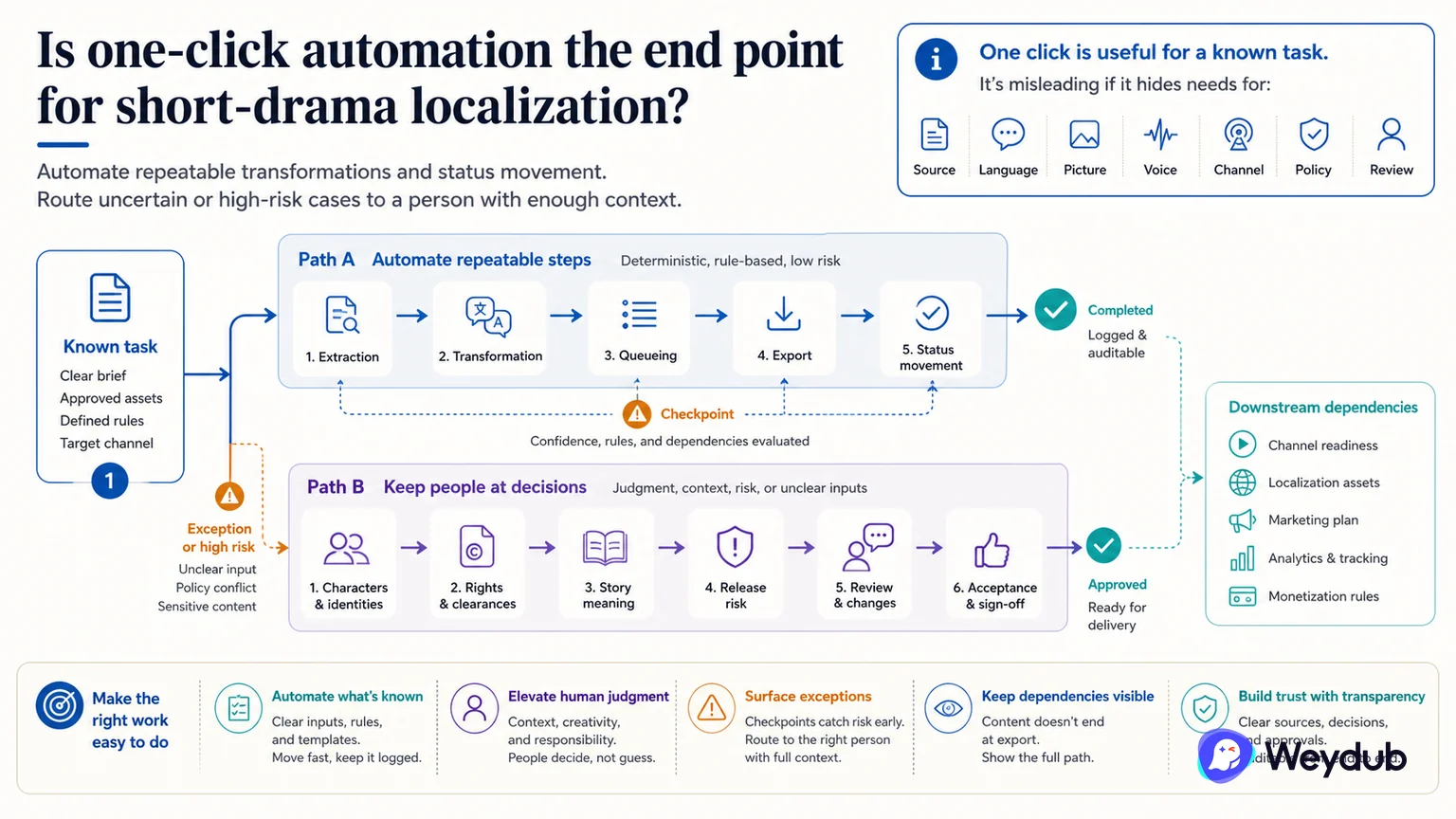
Automation is valuable for repeatable actions, but a release still needs context, rights, exception handling, review, and acceptance.
Key conclusions
- Automate repeatable transformations and status movement.
- Keep people at decisions involving characters, rights, story, and release risk.
- Make exceptions and downstream dependencies visible instead of hiding them behind one button.
A one-click action can be a useful interface for a known task. It becomes misleading when it implies that a source, language, picture, voice, and channel package are equally predictable. The workflow still needs to know what input was used, which policy was selected, and what output requires review.
The strongest operating model is not fully manual or fully automatic. It automates repeated extraction, transformation, queueing, and export while routing uncertain or high-risk cases to a person with enough context to decide.
A quality promise should describe the path and the acceptance criteria. A faster first output is useful when it shortens the route to a reviewable decision, not when it hides an unresolved production problem.
One click is an interface, not a release guarantee
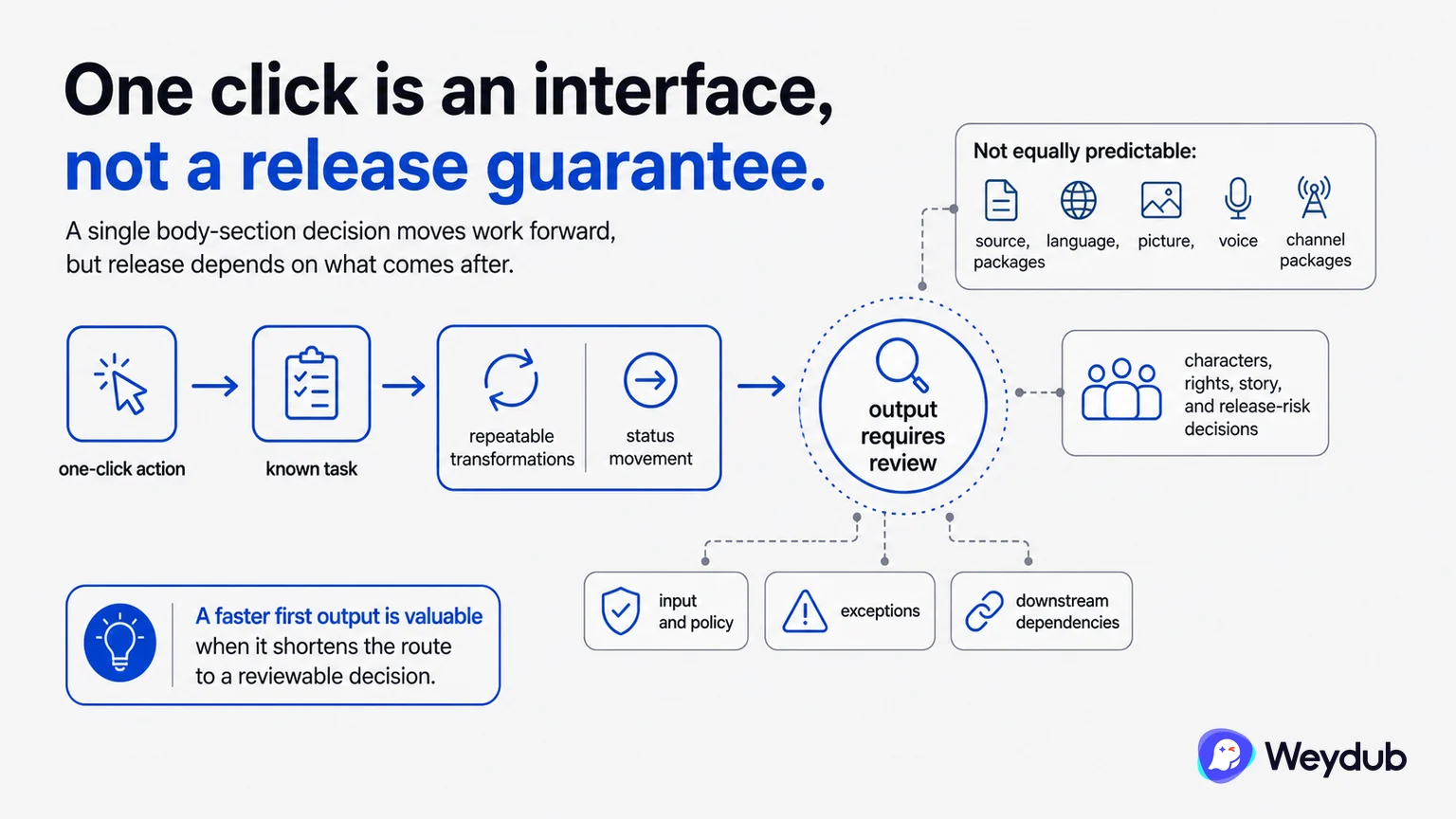
A one-click action can be useful for a known task. It becomes misleading when it implies that source, language, picture, voice, and channel packages are equally predictable. The workflow still needs to know which input and policy were used and what output requires review.
A faster first output is valuable when it shortens the route to a reviewable decision, not when it hides an unresolved production problem.
- Automate repeatable transformations and status movement.
- Keep characters, rights, story, and release-risk decisions visible.
- Make exceptions and downstream dependencies inspectable.
Route uncertainty instead of hiding it
The strongest model is neither fully manual nor fully automatic. It automates extraction, transformation, queueing, and export while routing uncertain or high-risk cases to a person with enough context to decide. Technical success and business approval remain separate states.
| Automation area | Good candidate | Human boundary |
|---|---|---|
| Extraction | Known source and format | Ambiguous text, speakers, regions |
| Translation | Stable terms and low-risk draft | Roles, plot, humor, legal language |
| Media | Repeatable picture or audio task | Faces, motion, performance, rights |
| Delivery | Manifest and status movement | Acceptance, channel, publication |
Define the acceptance path
A quality promise should describe the path and acceptance criteria. Record source version, policy, output, reviewer, exceptions, and dependent assets. This lets automation scale without treating uncertainty as a missing button.
- Define the known task and input policy.
- Automate the repeatable path.
- Route uncertain or high-risk cases to review.
- Verify dependent outputs and package state.
- Record acceptance and exceptions.
Frequently asked questions
Can one click produce a publishable series?
Usually not without defined source, context, rights, review, and delivery state. One click may start or automate a task, but acceptance is a separate decision.
Is manual work the opposite of automation?
No. A mature workflow automates repeatable steps and focuses human attention on decisions and exceptions.
Related theme: Industry observations
Weydub workflow
Take the next production step
Apply the decision framework to a repeatable localization workflow with visible assets, tasks, and handoffs.