
Source readiness
A source-material health check before localizing a short drama
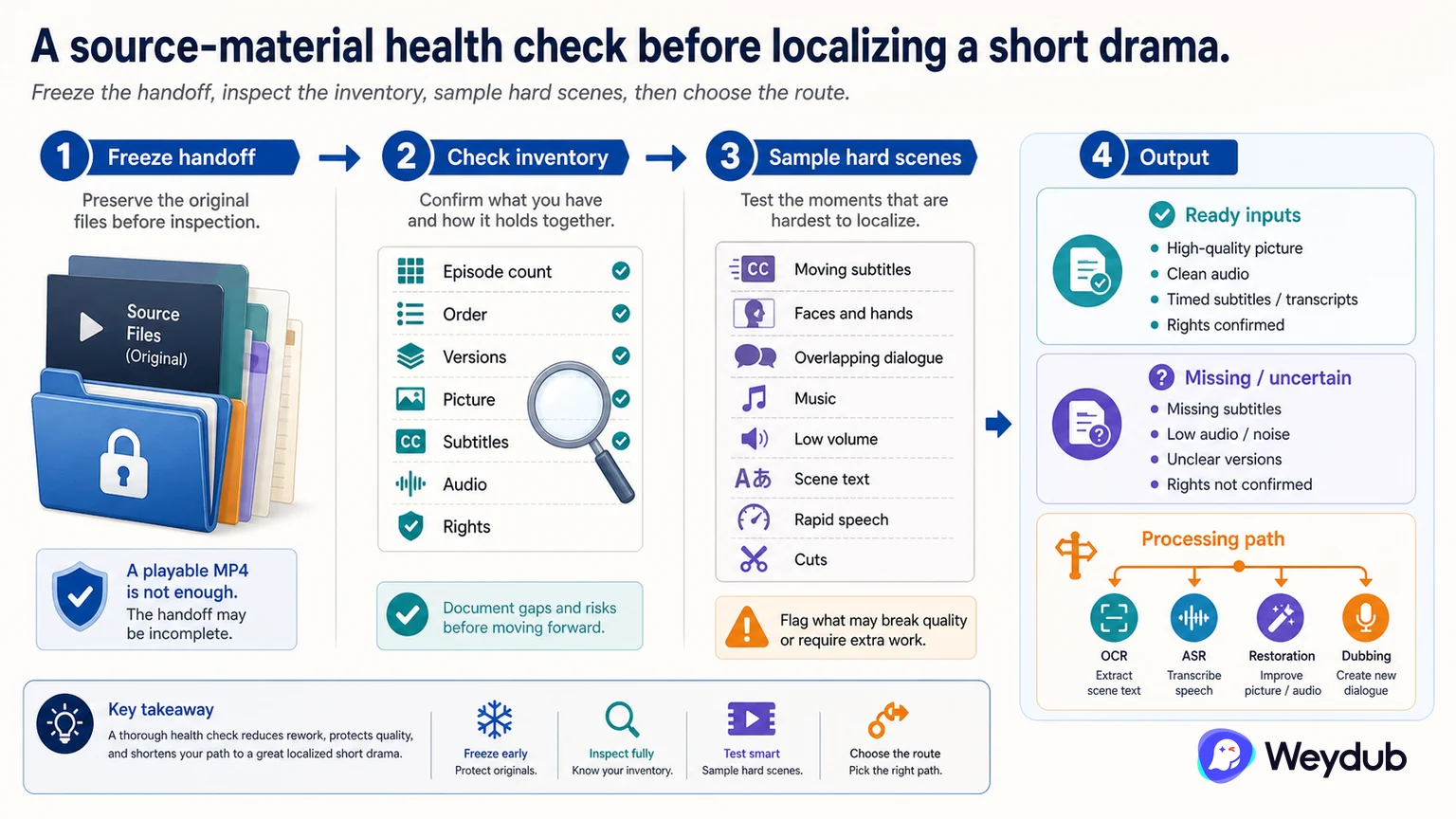
A short intake review can prevent a full batch from being built on the wrong master, missing audio, or incomplete episode set.
Key conclusions
- Freeze and preserve the original handoff before inspection.
- Check episode order, versions, picture, subtitles, audio, and rights.
- Sample difficult scenes before choosing OCR, ASR, restoration, or dubbing settings.
Start with an inventory that does not modify the files. Confirm the episode count, names, duration, resolution, duplicates, language labels, subtitle tracks, audio channels, and version signals. A missing episode or mixed master can invalidate every downstream assumption.
Then sample hard cases: moving subtitles, faces and hands, overlapping dialogue, music, low volume, scene text, rapid speech, and cuts. The goal is not to prove that ordinary footage works; it is to identify the route and risk before a batch is scheduled.
The health check should end with three lists: ready inputs, missing or uncertain inputs, and the proposed processing path. Keep the result attached to the project so later estimates can be explained.
Inspect the material before choosing the workflow
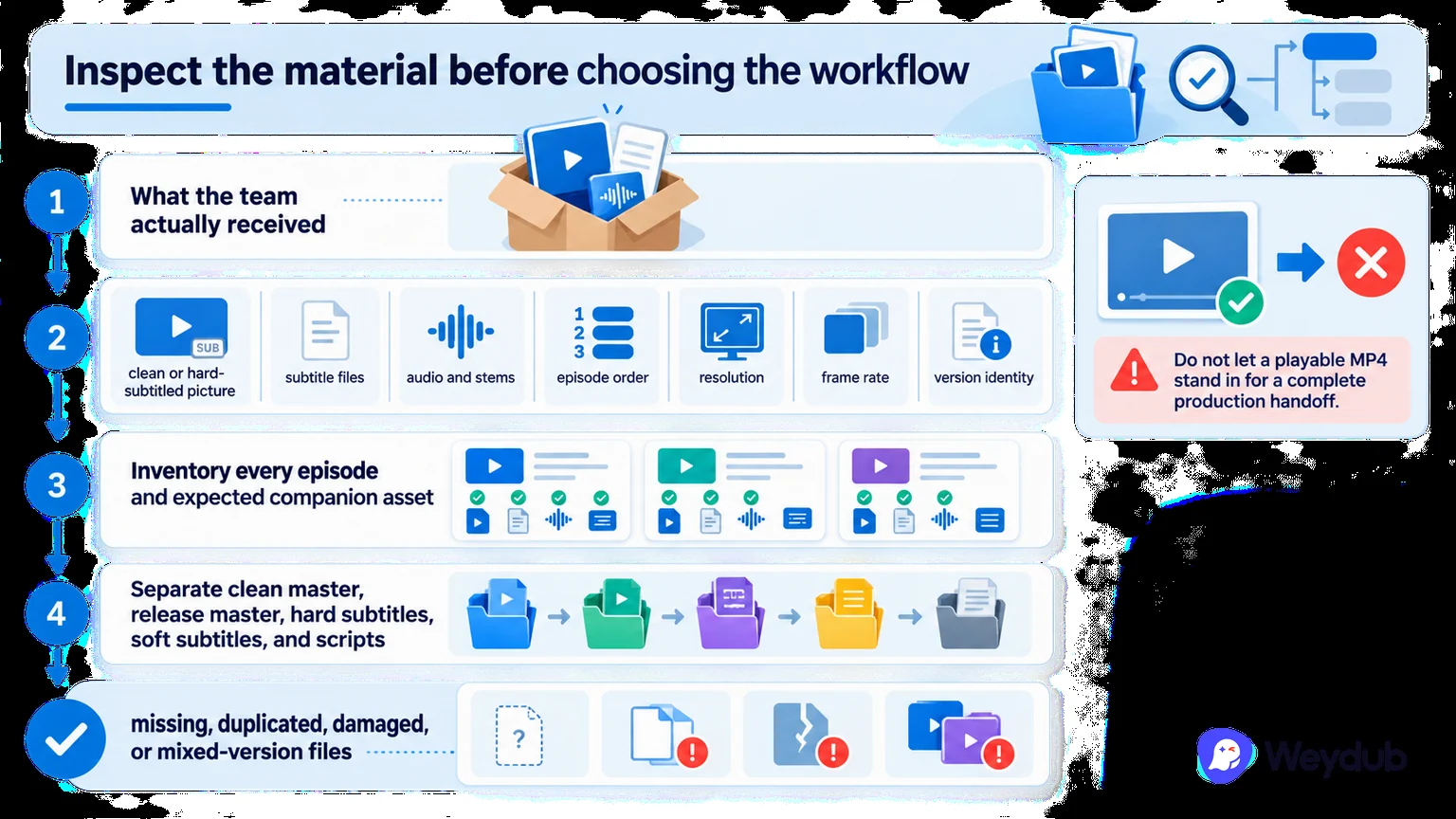
A source check should answer what the team actually received: clean or hard-subtitled picture, subtitle files, audio and stems, episode order, resolution, frame rate, and version identity. Do not let a playable MP4 stand in for a complete production handoff.
- Inventory every episode and expected companion asset.
- Separate clean master, release master, hard subtitles, soft subtitles, and scripts.
- Record missing, duplicated, damaged, or mixed-version files before processing.
Sample the conditions that drive rework
Check opening scenes, text over faces and hands, motion, scene cuts, music, quiet speech, multiple speakers, and end cards. The purpose is to expose the expensive cases, not to prove the cleanest shot works.
| Material area | What to inspect | Possible consequence |
|---|---|---|
| Picture | Resolution, compression, motion, subtitle region | Restoration or source recovery |
| Text | Format, language, timing, version | OCR, ASR, or subtitle correction |
| Audio | Dialogue, music, effects, channels | ASR, stems, mix, or dubbing scope |
| Series | Episode order and shared context | Batch and version risk |
End with a production decision
The health check should produce a route: use the supplied source, recover missing evidence, run a limited sample, change the release tier, or stop. Attach the decision to the source version so later teams know why the workflow began where it did.
- Inventory and preserve the handoff.
- Inspect representative difficult clips.
- Classify source, text, picture, audio, and rights risks.
- Choose the smallest valid recovery or production path.
- Record acceptance and unresolved exceptions.
Frequently asked questions
Can a source health check be skipped for a small project?
A small project can use a shorter checklist, but it still needs to know what picture, text, audio, version, and rights inputs it is using.
Is a high-resolution file automatically a clean master?
No. Resolution does not tell you whether subtitles are burned in, whether the audio is separated, or whether the file is the approved source.
Related theme: Localization production
Weydub workflow
Take the next production step
Connect episodes, language work, review, and delivery when a short drama needs more than a one-off file transformation.