
AI production
Why AI dramas still often use localization instead of regenerating every language
Lower generation cost does not make every language version a separate creative production decision.
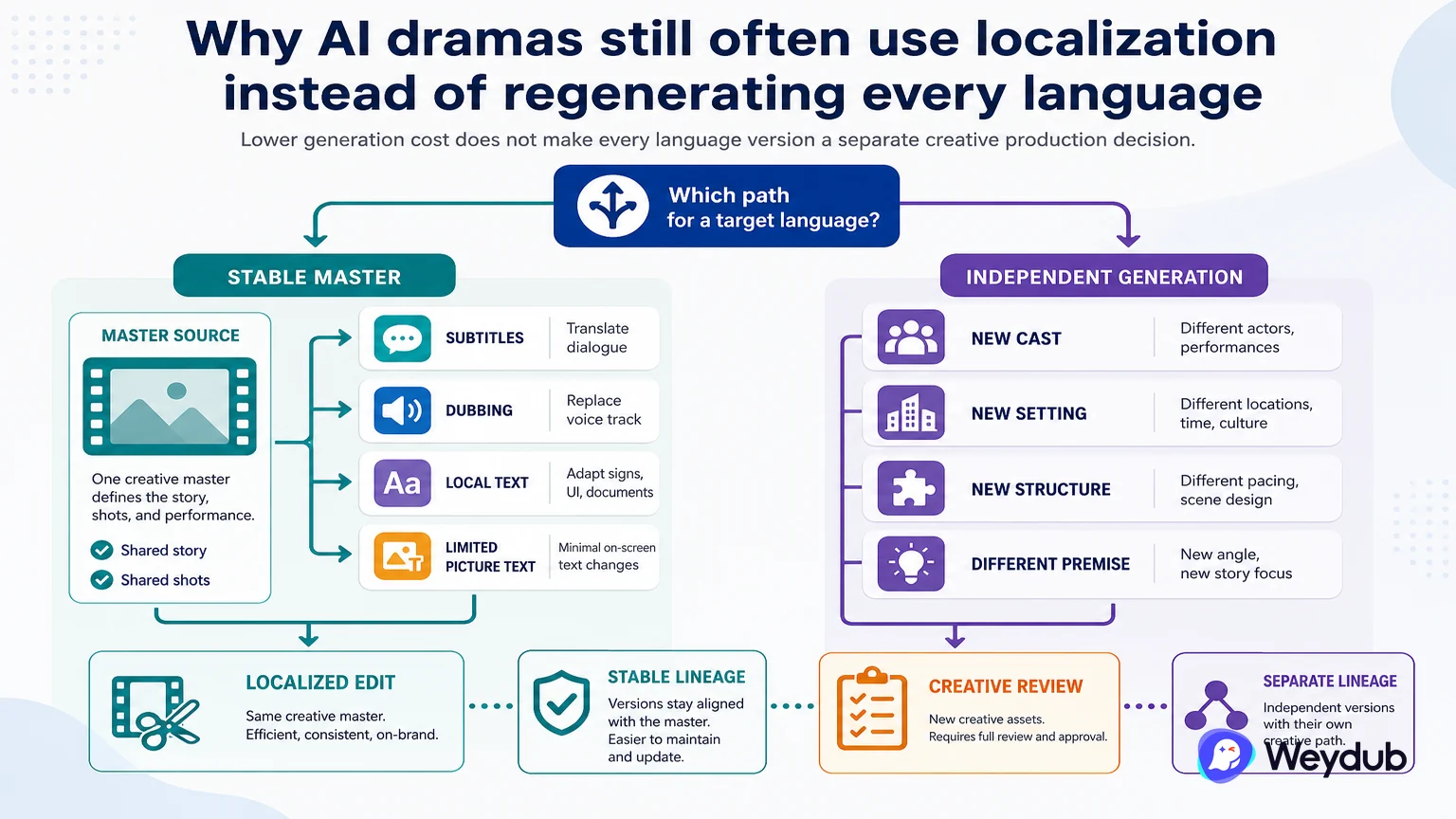
Key conclusions
- Keep a stable master when story, characters, and shots should remain shared.
- Derive subtitles, voices, and limited picture text changes from the approved source.
- Choose independent generation only when the target version truly needs different creative assets.
Generating a master and extending it into another language are different cost and consistency problems. If each language creates new shots, character actions, and timing, a language correction may require a new creative review rather than a localized edit.
A stable master lets teams reuse story facts, character context, episode order, and selected picture assets. Translation, subtitles, dubbing, and local text can then be reviewed as dependent versions. This does not make every localized output simple, but it makes the scope of a correction clearer.
Independent generation can be appropriate when the target audience needs a different cast, setting, story structure, or cultural premise. The important question is not whether a model can generate another language, but whether the organization is willing to maintain another production lineage.
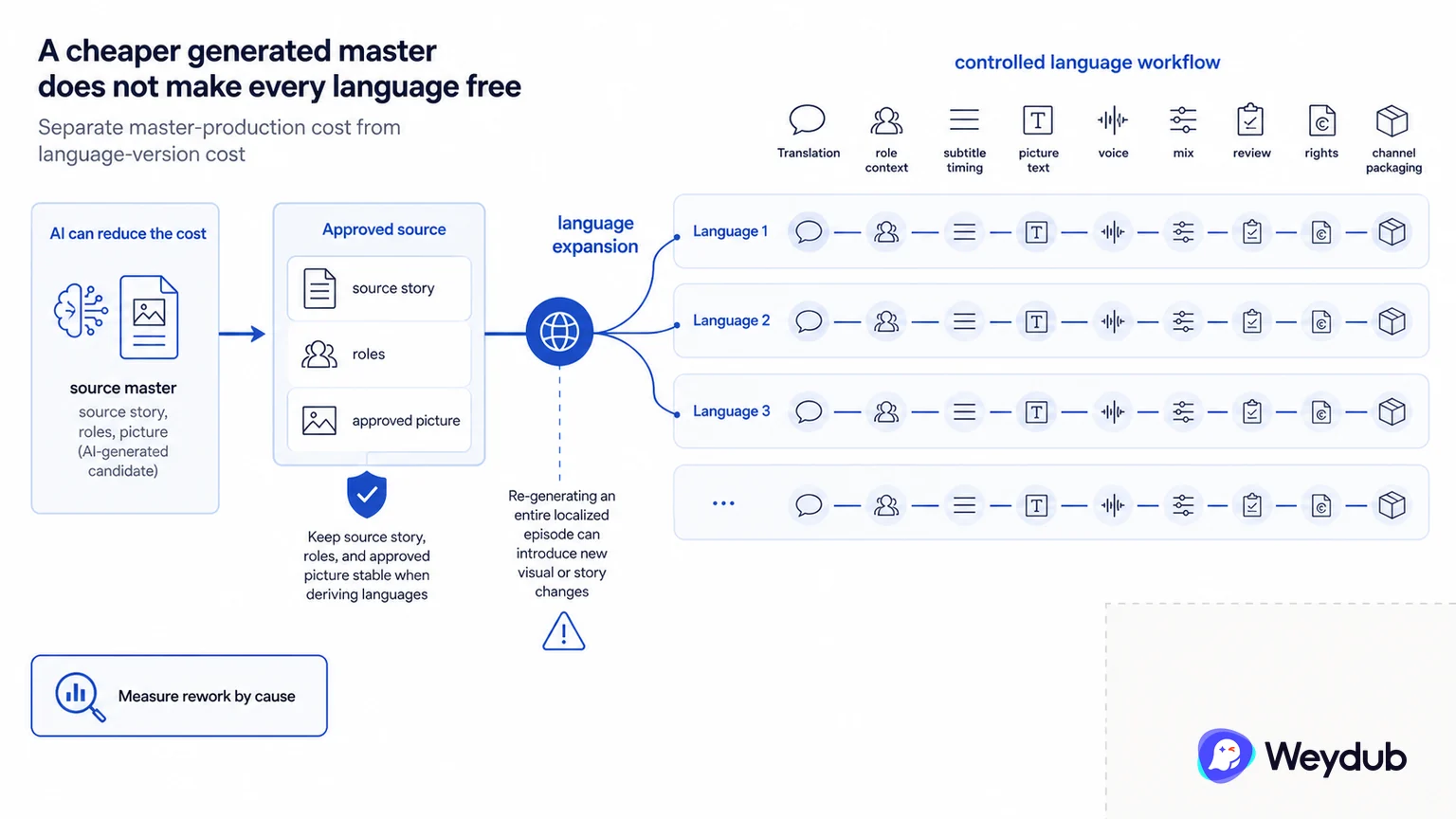
A cheaper generated master does not make every language free
AI can reduce the cost of creating candidate scenes or a source master, but language expansion still has its own inputs and acceptance work. Translation, role context, subtitle timing, picture text, voice, mix, review, rights, and channel packaging remain separate decisions.
Re-generating an entire localized episode can introduce new visual or story changes. When the source story and picture are approved, a controlled language workflow often protects more continuity than rebuilding the scene.
- Separate master-production cost from language-version cost.
- Keep source story, roles, and approved picture stable when deriving languages.
- Measure rework by cause instead of describing every change as model failure.
Language versions depend on shared context
A multilingual series should carry episode order, character records, glossary, subtitle style, source timing, picture treatment, voice mapping, and delivery requirements into every target language. Without that context, each language team may make a locally fluent decision that breaks series continuity.
Shared context does not force every language to use identical wording. It gives reviewers a way to explain why a local choice is intentional and which outputs need rechecking when a source decision changes.
| Shared asset | Why it matters | Language-specific decision |
|---|---|---|
| Character record | Protects identity and relationships | Name, address, voice, register |
| Glossary | Protects recurring terms | Natural target-language expression |
| Source timing | Anchors scene and dialogue | Reading or speaking duration |
| Delivery brief | Protects channel requirements | Metadata, style, and package |
Choose the right depth for each market
Not every market needs the same version depth at the same time. A subtitle sample may answer an early demand question; a dubbed release may be justified when the audience, channel, and performance requirements are clear. Keep each output connected to the approved source and review state so a correction can stay local when it is local and propagate when it must.
- Approve the source master and rights scope.
- Define target locale, channel, and version depth.
- Prepare a representative language sample.
- Review high-risk scenes and recurring context.
- Scale the language batch with explicit version and delivery state.
Frequently asked questions
Does AI-generated content remove localization review?
No. It can change where effort is spent, but role, language, picture, voice, rights, and delivery decisions still need review.
Should every target language receive the same picture and voice work?
Not necessarily. Match version depth to audience, channel, rights scope, and evidence of release value.
Related theme: AI media workflows
Weydub workflow
Take the next production step
Keep automation, review, and delivery connected when AI-generated media needs to become a usable release.