
Growth economics
Why short-drama app acquisition cannot be judged by install cost alone
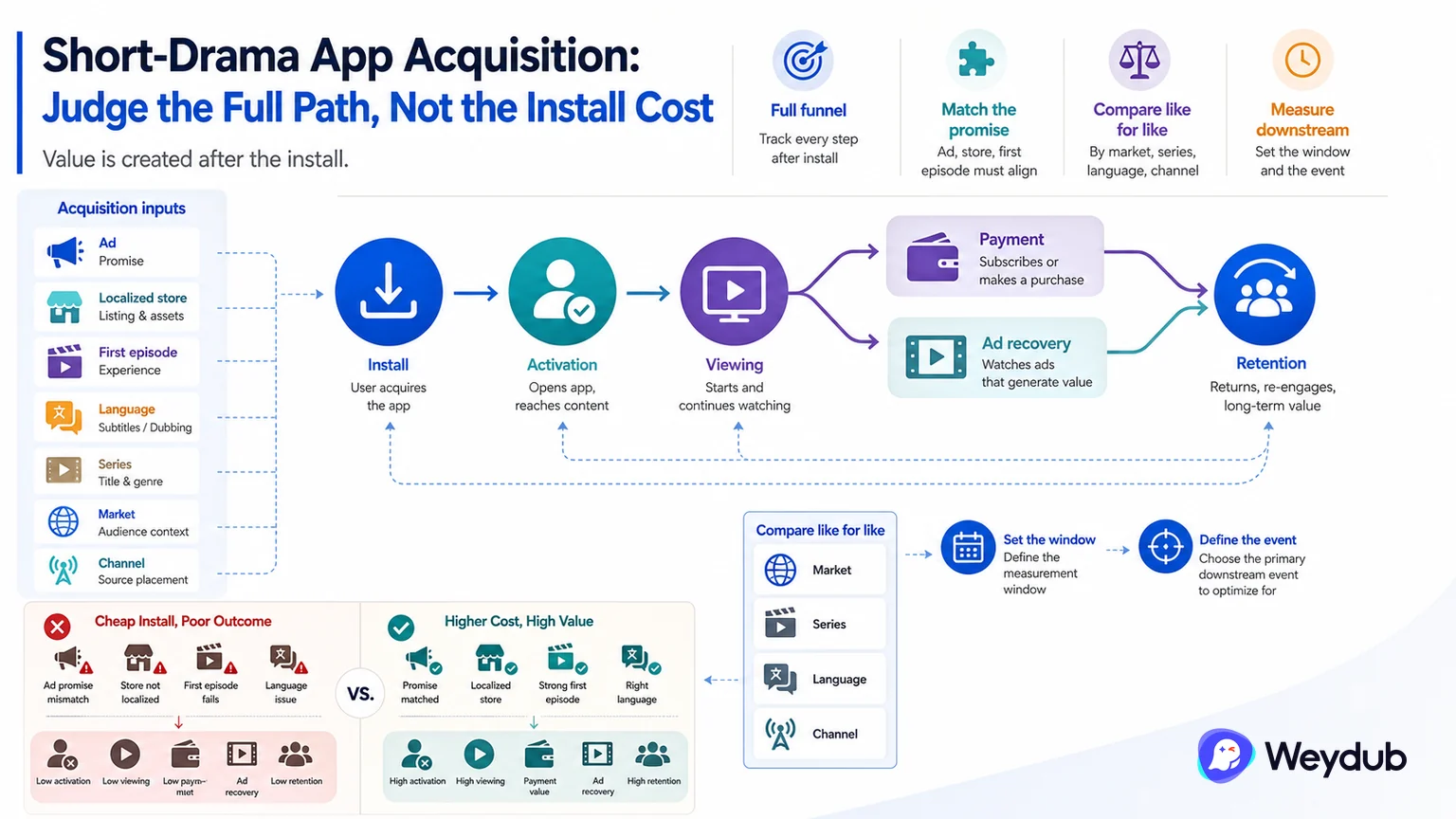
The useful unit is the path from acquisition to activation, viewing, payment or ad recovery, and retention.
Key conclusions
- Track the full funnel after the install.
- Match the ad promise to the localized store and first-episode experience.
- Compare recovery by market, series, language, and channel rather than one blended average.
An inexpensive install can be a poor acquisition if the user does not find the promised story, cannot follow the language, or leaves before the first meaningful action. A more expensive source may be valuable if it brings viewers who watch, pay, return, or generate sustainable ad recovery.
Localization affects this funnel directly. The ad, store page, app interface, title, subtitles, dubbing, price display, and first episode should agree. A mismatch can look like a media problem when the real failure is content or product handoff.
Set the measurement window and downstream event before running a test. Then compare the same series and language conditions with enough context to tell whether the problem belongs to acquisition, localization, product, or retention.
A cheap install can buy the wrong user
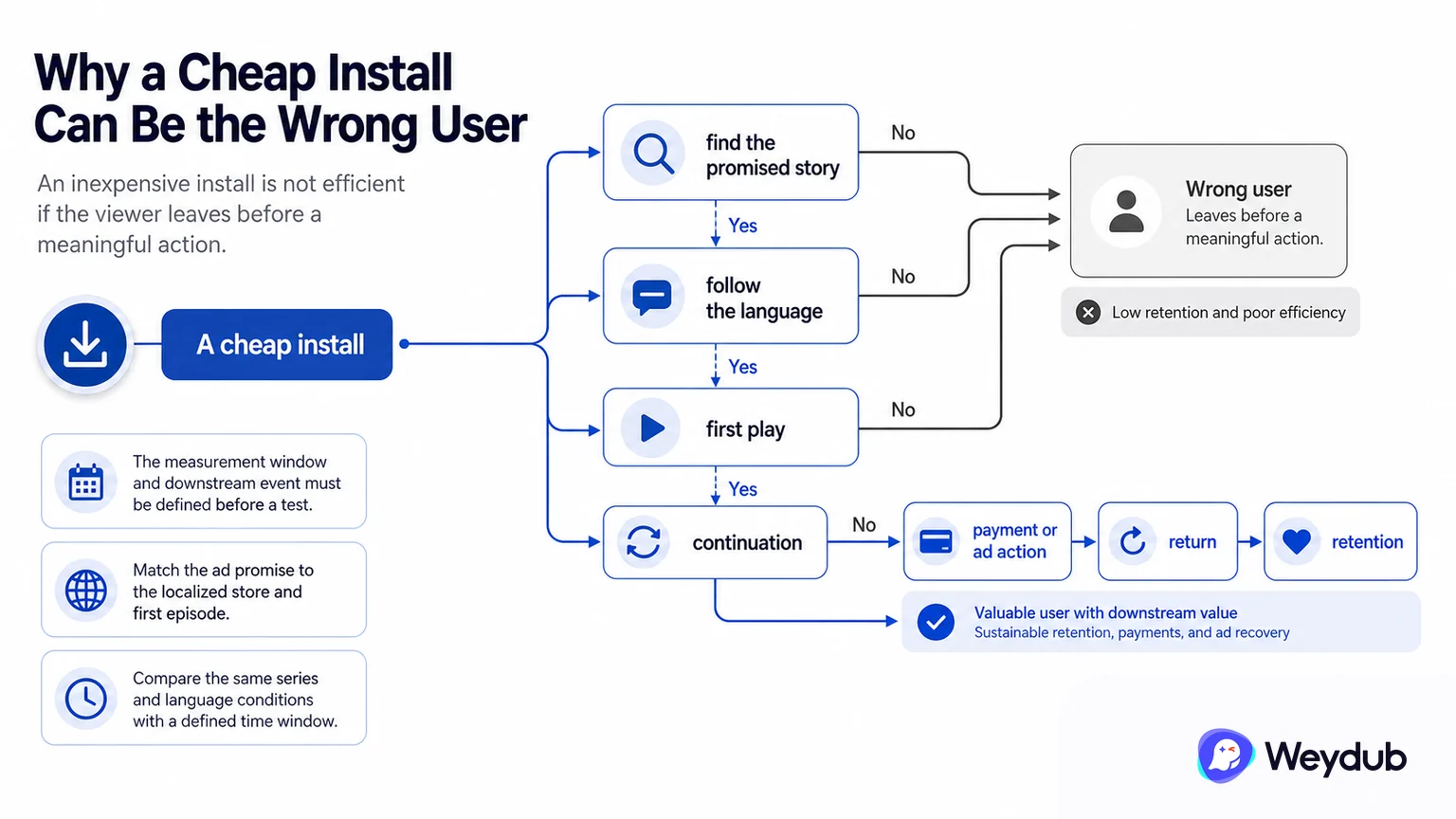
An inexpensive install is not necessarily an efficient acquisition if the user does not find the promised story, cannot follow the language, or leaves before a meaningful action. A more expensive source may be valuable when its viewers watch, pay, return, or generate sustainable ad recovery.
The measurement window and downstream event must be defined before a test. Otherwise teams optimize the first cheap signal without knowing whether it leads to viewing, payment, ad recovery, or retention.
- Track first play, continuation, payment or ad action, and return.
- Match the ad promise to the localized store and first episode.
- Compare the same series and language conditions with a defined time window.
Localization is part of the acquisition funnel
The ad, store page, app interface, title, subtitles, dubbing, price display, and first episode should agree. A mismatch can look like a media problem when the real failure is the handoff between acquisition, product, and localized content.
Compare market, series, language, channel, creative, and product version together. A blended average hides whether the defect belongs to targeting, language, story, payment, or retention.
| Funnel stage | Question | Localization check |
|---|---|---|
| Promise | What does the ad or store promise? | Language, title, genre, version |
| Activation | Can the user reach the first story moment? | Onboarding, UI, playback, subtitle/audio |
| Value | Does the audience continue or pay? | Episode flow, paywall, ad logic |
| Retention | Why return? | Series consistency, updates, support |
Run acquisition tests as versioned experiments
Keep campaign asset, store version, content language, series, territory, and downstream events linked. This lets the team decide whether to change the creative, localization, product handoff, or market rather than simply increasing or decreasing spend.
- Define the audience and downstream success event.
- Align acquisition, store, app, and first episode language.
- Run a bounded test with versioned assets.
- Reconcile installs with viewing, payment, ads, and returns.
- Scale only the path that produces sustainable evidence.
Frequently asked questions
Is CPI a useful metric?
It is useful as an acquisition signal, but it cannot decide channel quality without downstream viewing, conversion, retention, rights, and operating cost.
Can localization change acquisition performance?
Yes. A mismatch between creative, store, interface, language, payment, and first episode can reduce activation and retention.
Related theme: Short-drama globalization
Weydub workflow
Take the next production step
Move from a market and source decision to a reviewable multi-episode localization workflow.