
Team design
How many people does a short-drama localization project need?
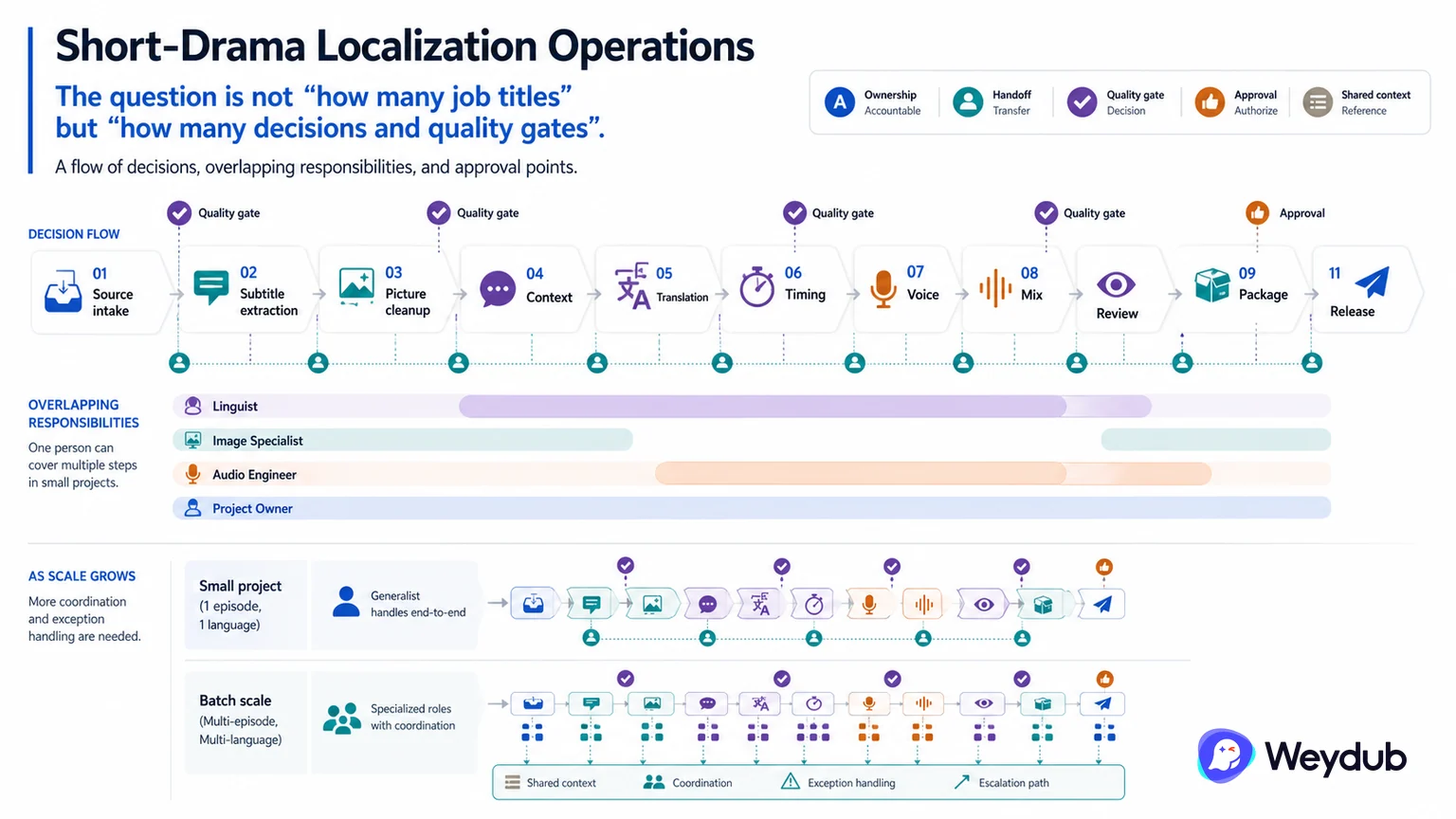
Count the decisions and quality gates before counting job titles.
Key conclusions
- Separate translation, picture, audio, review, and delivery actions.
- One person may hold several roles in a small project.
- Batch scale increases coordination and exception handling even when tools automate steps.
A one-off clip can be handled by a small team with overlapping responsibilities. A multi-episode, multi-language release adds source preparation, terminology, character context, translation, subtitle timing, picture restoration, voice direction, mixing, review, packaging, and publishing coordination.
The right question is not whether every action needs a separate employee. It is whether every decision has an owner and every handoff has a testable output. A translator may also review timing; a project manager may coordinate delivery; an external studio may provide voices while the release owner accepts the mix.
As the series grows, shared context and status become more important. Studio and API workflows can reduce manual coordination, but they do not remove the need to define who approves the final version.
Count decisions before job titles
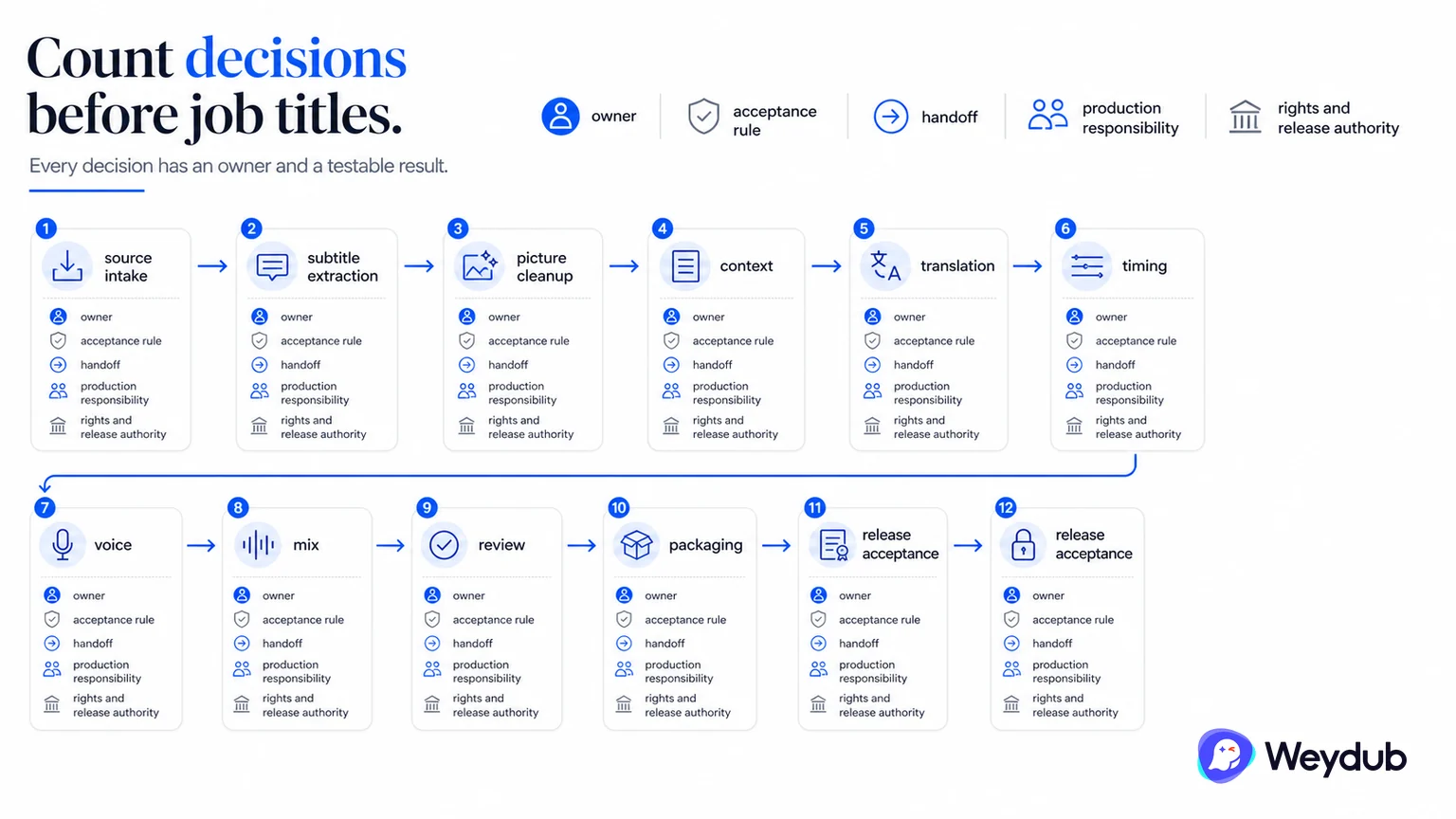
A short localization project may combine several responsibilities in one person, but the work still contains distinct decisions: source intake, subtitle extraction, picture cleanup, context, translation, timing, voice, mix, review, packaging, and release acceptance.
The useful staffing question is whether every decision has an owner and every handoff has a testable result. A small team can be efficient when the overlap is explicit; it becomes fragile when nobody knows who can approve a disputed term or final mix.
- List the actions the release actually requires.
- Assign an owner and an acceptance rule to each action.
- Separate production responsibility from rights and release authority.
A small team can combine roles
One person may coordinate source checks, translation review, and delivery for a short batch. Another may handle editing, subtitle timing, and picture checks. That is a staffing choice, not permission to remove the checks themselves.
Record which role is being performed at each stage. The translator may recommend a line, the voice director may direct performance, and the release owner may accept the final version even when one person holds two of those roles.
- Keep review independent enough to catch avoidable mistakes.
- Use a shared glossary, role record, and issue log when responsibilities overlap.
- Make the final acceptance owner explicit.
Scale coordination before adding complexity
As episodes, languages, and channels increase, coordination and exception handling become the limiting work. Shared series context, status, version relationships, and batch visibility reduce repeated decisions; they do not remove the need for review or accountable release ownership.
Studio and API workflows can automate repeated tasks, but teams still need to decide who owns the queue, who resolves failed or ambiguous outputs, and who accepts the delivery package.
- Map the production and release actions.
- Assign owners and backup owners.
- Define review gates for source, language, media, and delivery.
- Use shared state for batches, versions, and exceptions.
- Reassess staffing when volume or language count changes.
Frequently asked questions
Can one person localize a short drama?
For a small scope, one person can hold several roles. The project still needs explicit source, language, media, and delivery checks, and a clear acceptance decision.
Does automation eliminate localization roles?
It reduces repetitive handling in some steps, but context, rights, language judgment, media review, and release responsibility remain necessary.
Related theme: Stakeholders, rights, and responsibilities
Weydub workflow
Take the next production step
Keep source, language, review, and delivery boundaries clear as partners and rights scope change.