
Contextual translation
Why short-drama translation cannot be handled one cue at a time
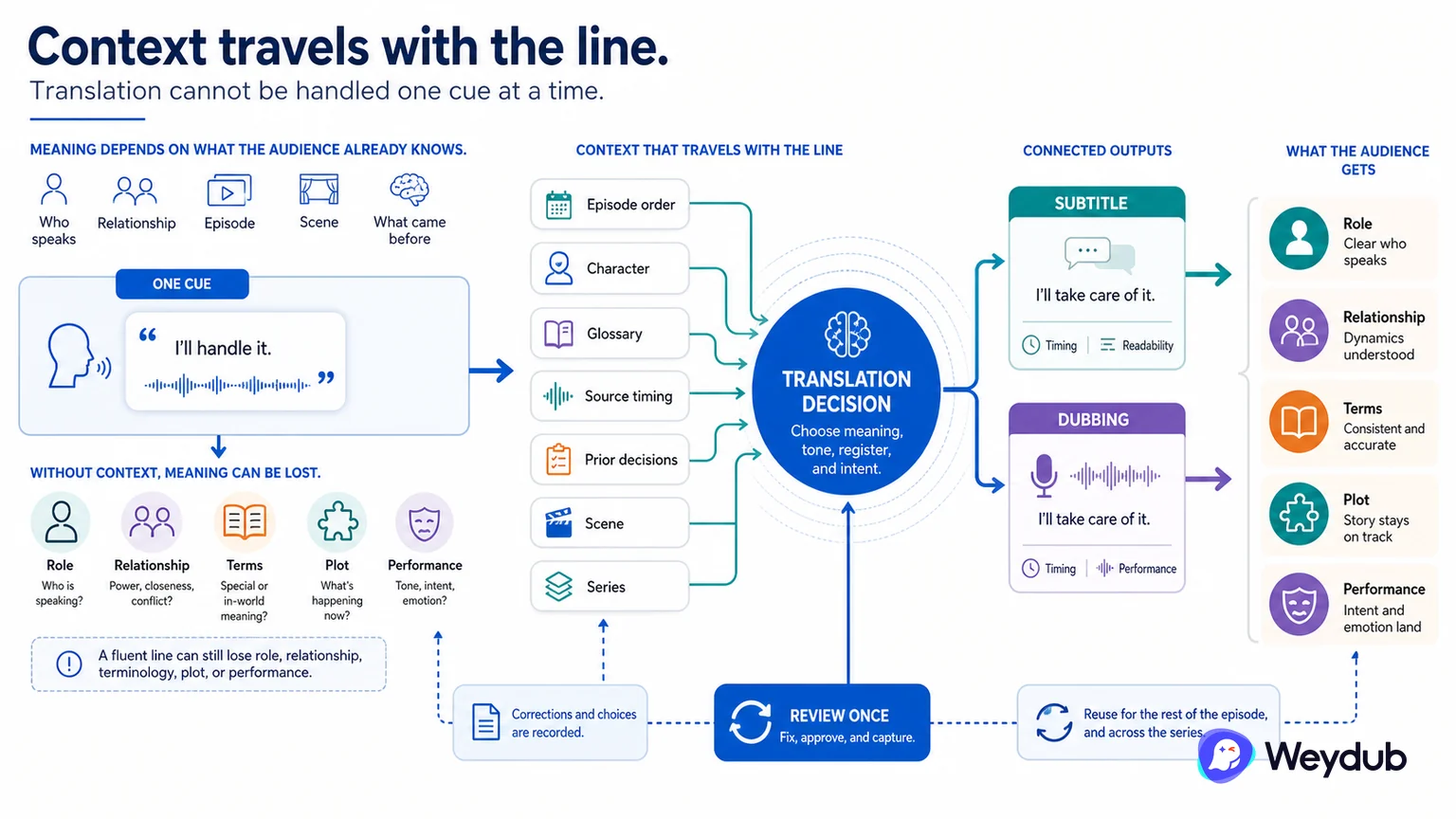
Fluent individual lines can still lose role, relationship, terminology, plot, or performance when the series context is missing.
Key conclusions
- Carry episode, character, glossary, and source timing into translation.
- Review lines in scene and series context, not only as isolated strings.
- Keep subtitle and dubbing constraints connected to the translation decision.
Short drama compresses relationships and plot into few lines. A pronoun, title, or repeated phrase may change meaning because of who is speaking, what happened earlier, or what the next episode reveals. A line-by-line workflow can produce grammatical text while losing that structure.
Context does not require a long literary brief for every cue. It means the system can provide the useful facts: episode order, character identity, approved terms, source timing, prior decisions, and review state. This lets a correction be made once and reused appropriately.
When the translation feeds dubbing, the target line also needs to fit performance and timing. Meaning, reading density, segmentation, and voice should be reviewed as connected outputs.
A cue without context is an incomplete translation task
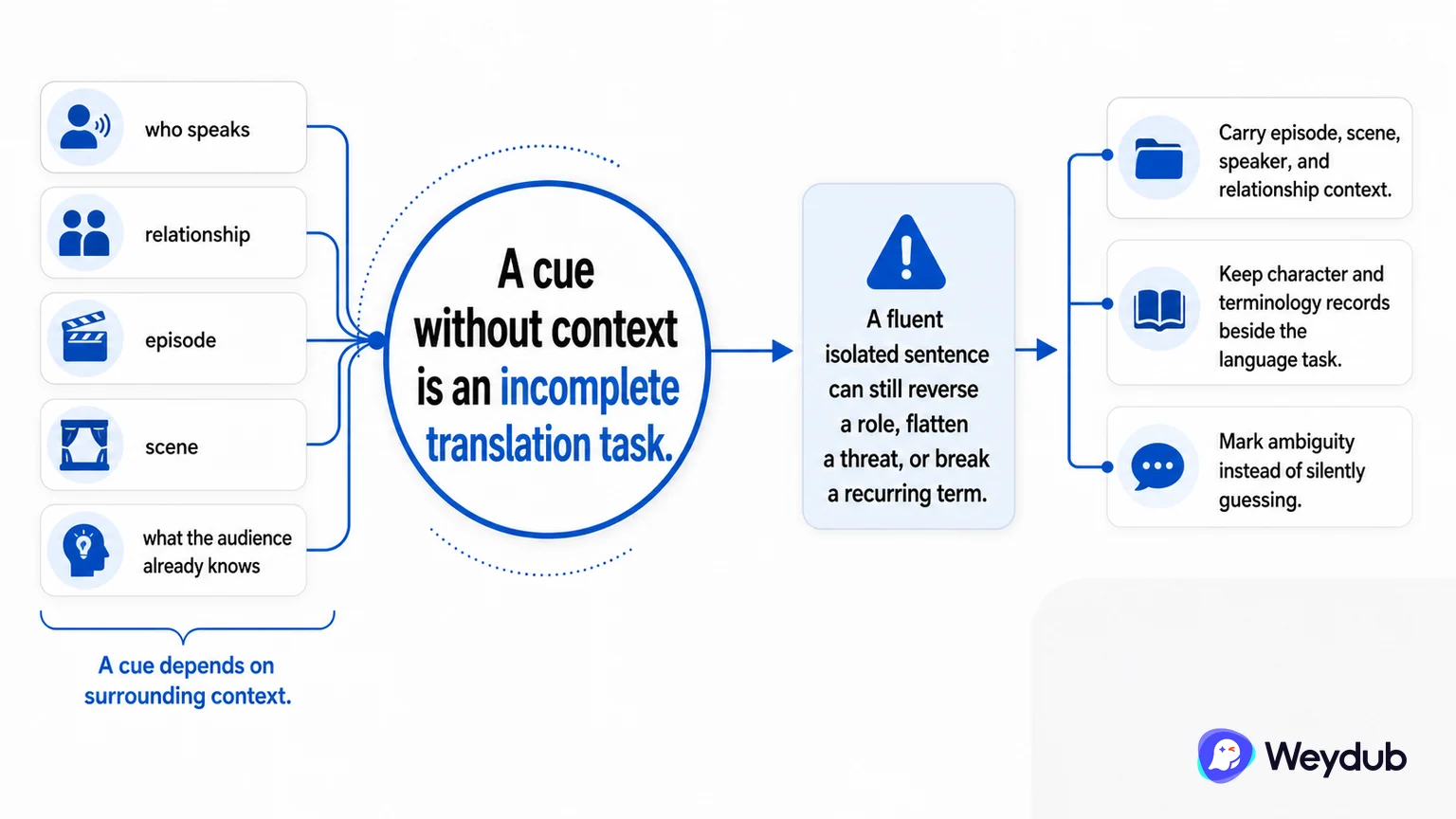
Short-drama lines depend on who speaks, the relationship, the episode, the scene, and what the audience already knows. A fluent isolated sentence can still reverse a role, flatten a threat, or break a recurring term.
- Carry episode, scene, speaker, and relationship context.
- Keep character and terminology records beside the language task.
- Mark ambiguity instead of silently guessing.
Translate the series decision, not only the sentence
The useful context can be compact: approved names, aliases, forms of address, glossary terms, source timing, and style or channel constraints. This lets a team correct a shared decision once while keeping language-specific judgment in each branch.
| Context | Risk when missing | Control |
|---|---|---|
| Speaker and role | Wrong address or voice | Character record |
| Episode and scene | Lost reference or plot meaning | Episode context |
| Terminology | Drift across episodes | Glossary and scope |
| Timing | Unreadable or unperformable line | Cue and delivery review |
Keep subtitles and dubbing connected
A line written for the screen may not fit a natural performance. Review meaning, segmentation, reading speed, line length, and voice intent as connected outputs, then preserve the approved source and language decisions for later episodes.
- Freeze the source subtitle and context.
- Resolve role and terminology decisions.
- Translate for meaning and target-language rhythm.
- Check reading and performance constraints.
- Approve the language version with dependencies recorded.
Frequently asked questions
Can a machine translate a line without context?
It can produce a draft, but context is needed to control role, terminology, continuity, and release quality.
Does context mean every line needs a long brief?
No. A compact reusable series record plus the local scene context is usually enough.
Related theme: Subtitle and language systems
Weydub workflow
Take the next production step
Turn source video into reviewable subtitle material, then carry approved context into translation and delivery.