
Knowledge theme
Quality and review
Production quality comes from targeted review and local rework, not from hiding uncertainty behind a single score.
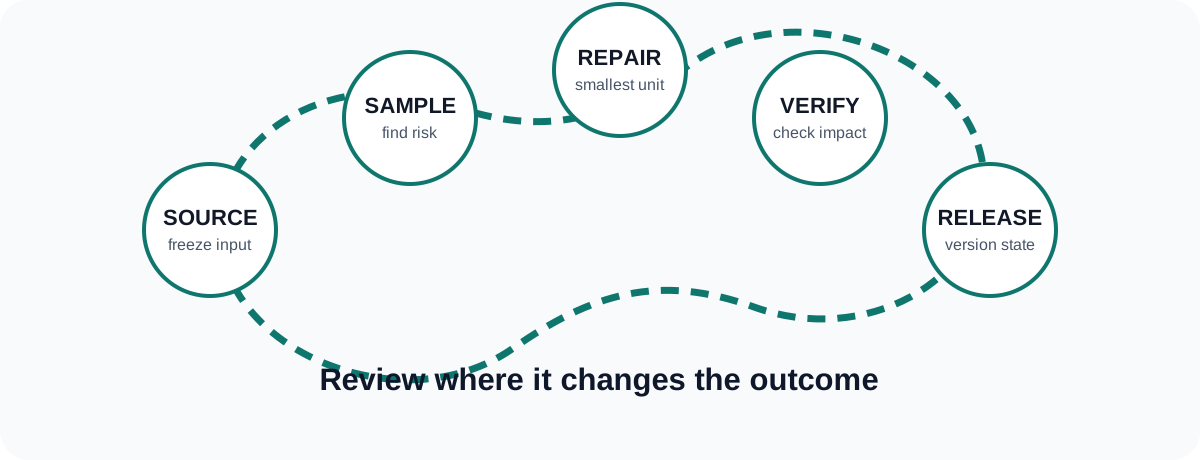
A reliable workflow identifies risk, samples the right units, and preserves enough context to fix a subtitle, voice, picture, or delivery defect.
Questions this theme connects
- What should be reviewed first?
- How can teams avoid regenerating a whole episode?
- Which claims need a sample and date?
Generated files are only the beginning
Models can generate subtitles, clean masters, translations, and voices. When a team works across dozens of episodes and several languages, it must also preserve characters, terminology, voice mappings, subtitle styles, review decisions, and the replacement relationship between versions.
A common failure is not an unreadable file but a correct-looking file built from the wrong decision. A name changes in one episode, the voice team records the correction, and delivery still takes the old export. Each person completed a task; the version relationship failed.
- Keep the approved source, series context, and language version visible.
- Record which output replaces which earlier version.
- Attach approval to an episode, language, and version instead of a chat message.
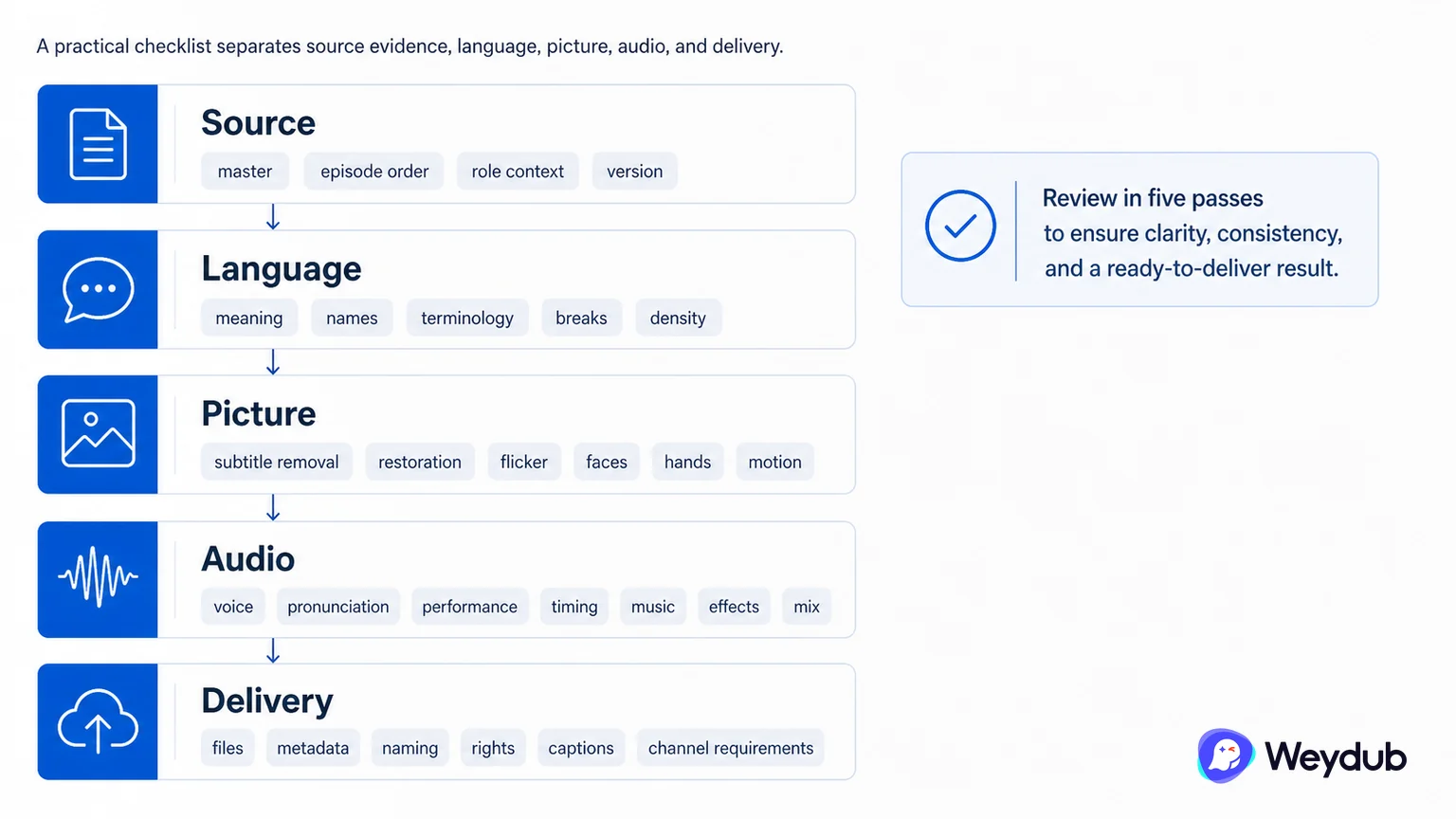
Separate four kinds of problems
System failure, incomplete output, content quality, and changed business requirements can all appear as a request to redo work, but they have different causes and costs. A missing file may need a scoped re-delivery. A repeated name error may require a glossary correction and downstream checks. A new dubbing requirement is a new delivery version, not proof that the original subtitle workflow failed.
| Problem class | Example | Correct response | Quality signal? |
|---|---|---|---|
| System failure | Timeout, dependency error, interrupted task | Recover and retry after checking state | Not necessarily |
| Incomplete output | 79 subtitle files for an 80-episode plan | Complete the missing unit and reconcile counts | Not necessarily |
| Content defect | Wrong term, missed removal, wrong role, wrong pronunciation | Correct the cause and rework the smallest valid unit | Record the specific reason |
| Requirement change | New language, voice tier, track, or channel package | Create a new business version | No |
Rework the smallest affected unit
Start by locating the cause rather than clicking a full-project retry. A translation defect belongs upstream in the target subtitle; a voice defect may be text, role, or voice mapping; a picture defect may be a region and time range. Unclear causes create repeated outputs with the same failure.
A local repair still needs regression review. Changing a cue can affect neighboring subtitles; changing a voice can affect the mix; repairing a picture region can change the background under a target subtitle. The team should verify the dependent outputs before approval.
- Locate episode, time range, language, and current version.
- Classify the defect as text, picture, role, voice, system, or delivery.
- Freeze approved assets and rework only the necessary unit.
- Check neighboring cues and downstream outputs.
- Record the new-versus-replaced relationship before delivery.
Delivery means more than downloading a final video
A series can have different versions by language, voice tier, subtitle track, channel, and rights window. A usable delivery record identifies the source master, episode order, target language, subtitle and voice assets, picture treatment, style, review state, channel, and release scope.
The final video is what the audience sees, but editable subtitles, clean masters, audio tracks, role records, and version notes determine whether the team can add a language, correct a name, change a voice, or adapt to a new channel without starting over.
- App release: preserve multi-episode language consistency and the approved content package.
- YouTube or social release: preserve captions, title, thumbnail, channel, rights, and audio strategy.
- Platform distribution: preserve clean master, tracks, metadata, contract scope, and technical acceptance.
Frequently asked questions
Does fixing one subtitle typo require redubbing the whole series?
Usually no. Locate the affected cue and language, regenerate the necessary voice and composite outputs, then check the neighboring dialogue and the full episode for audio-picture continuity.
Is the final video enough for delivery?
No. Clean masters, source and target subtitles, role and terminology records, voice mappings, and task history support later languages, style changes, voice changes, and secondary distribution.
Does review approval mean the asset can ship on every channel?
No. Content quality, rights, encoding, aspect ratio, metadata, and platform policy are separate release gates.
Follow the connected work
Editorial note. This theme is a map, not a ranking. Public product statements are kept separate from industry context and should be checked against the linked source and date.