
Quality operations
Turn review notes into a rework loop
A useful review comment identifies the defect, its scope, the owner, and the smallest output that must be checked again.
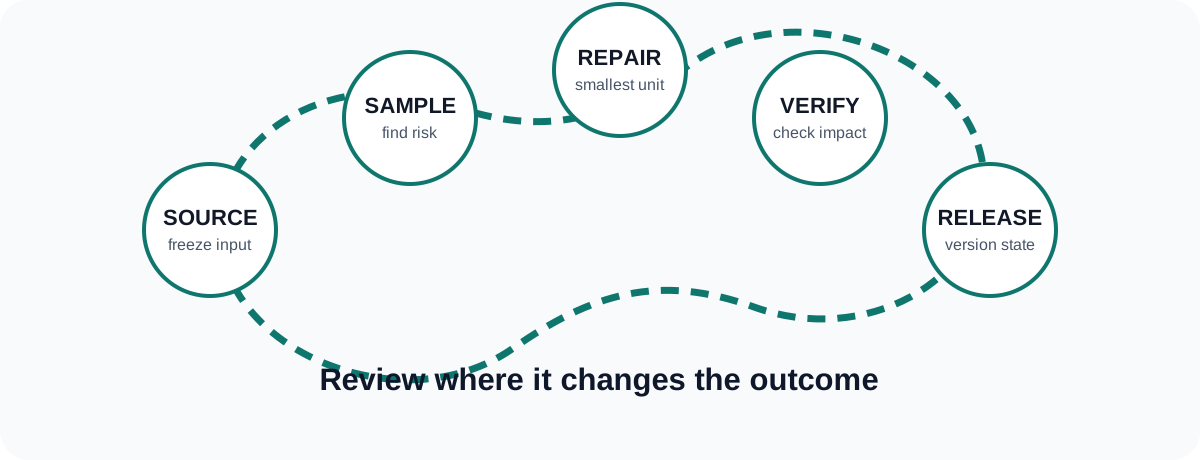
Direct answer: A rework loop should connect evidence to a specific issue, repair the smallest reusable unit, and verify every dependent output before approval.
What to keep clear
- Describe what is wrong and where it appears, not only that the output is poor.
- Classify whether the defect is source, language, picture, audio, timing, or delivery.
- Recheck propagated outputs after a shared decision changes.
Vague notes create duplicate work. A timestamp, cue, character, region, language, and expected correction give the next person something testable. The issue should also say whether the defect appears once or is likely to repeat across episodes.
The right repair unit may be a subtitle cue, role mapping, glossary entry, frame region, audio segment, or entire source version. Choosing the smallest unit that preserves consistency reduces unnecessary regeneration without hiding an upstream problem.
Related theme: Quality and review
Sources and scope. Weydub public review and rework workflow documentation. Checked 2026-08-25. This entry defines a working concept; it is not a universal legal, market, or performance claim.