
Alternative guide
How to choose a subtitle-removal approach
Compare a clean source, crop or edit, manual restoration, and AI-assisted picture repair by source condition and delivery need.
Direct answer: Choose the least destructive method that produces a usable master: use an existing clean source when available, crop only when composition allows it, and use controlled restoration when the picture must be preserved.
Checklist
- Check for a clean master before processing a burned-in version.
- Use crop or cover methods only when they do not damage the intended frame.
- Use AI-assisted restoration when the region and motion can be reviewed, then keep a human acceptance step.
There is no single best subtitle-removal method for every video. A clean source is the most reliable because it avoids reconstructing pixels. Cropping or reframing can be fast but changes the composition. Manual editing may work for a few shots, while a series needs a repeatable workflow with region, timing, and review state.
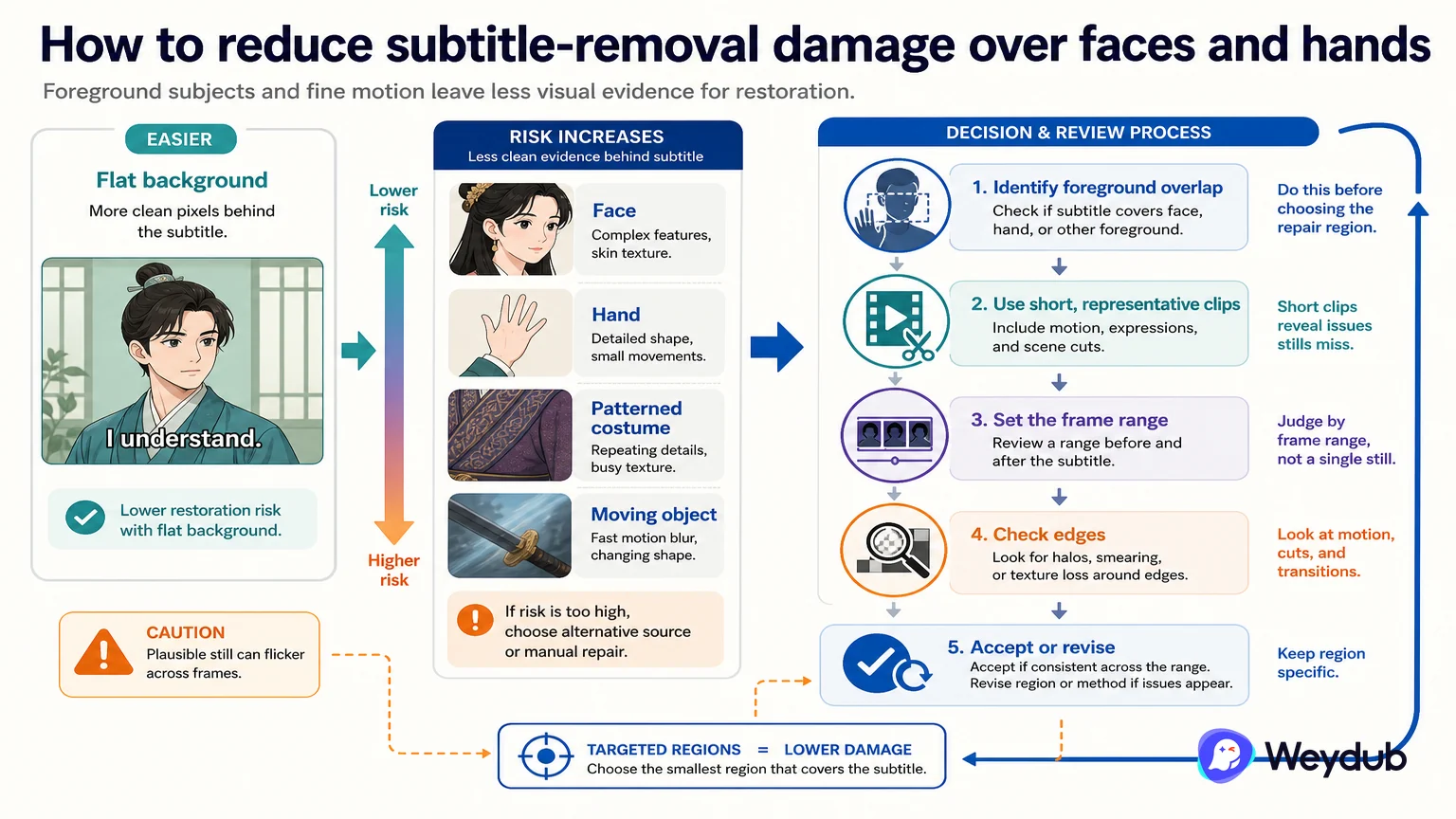
AI-assisted removal is useful when the original framing matters and the source contains enough visual evidence for restoration. It should still be evaluated by shot type rather than by a single success example. Faces, hands, fast movement, low resolution, and several subtitle regions deserve deliberate sampling.
The decision should end with a delivery check: does the repaired master preserve the intended picture, remain traceable to the source, and give subtitle, translation, or dubbing teams a stable input?
Related theme: Localization capabilities
Sources and scope. Weydub subtitle-removal technology explainer; Weydub public delivery and review guidance. Checked 2026-08-25.